Who needs a monster
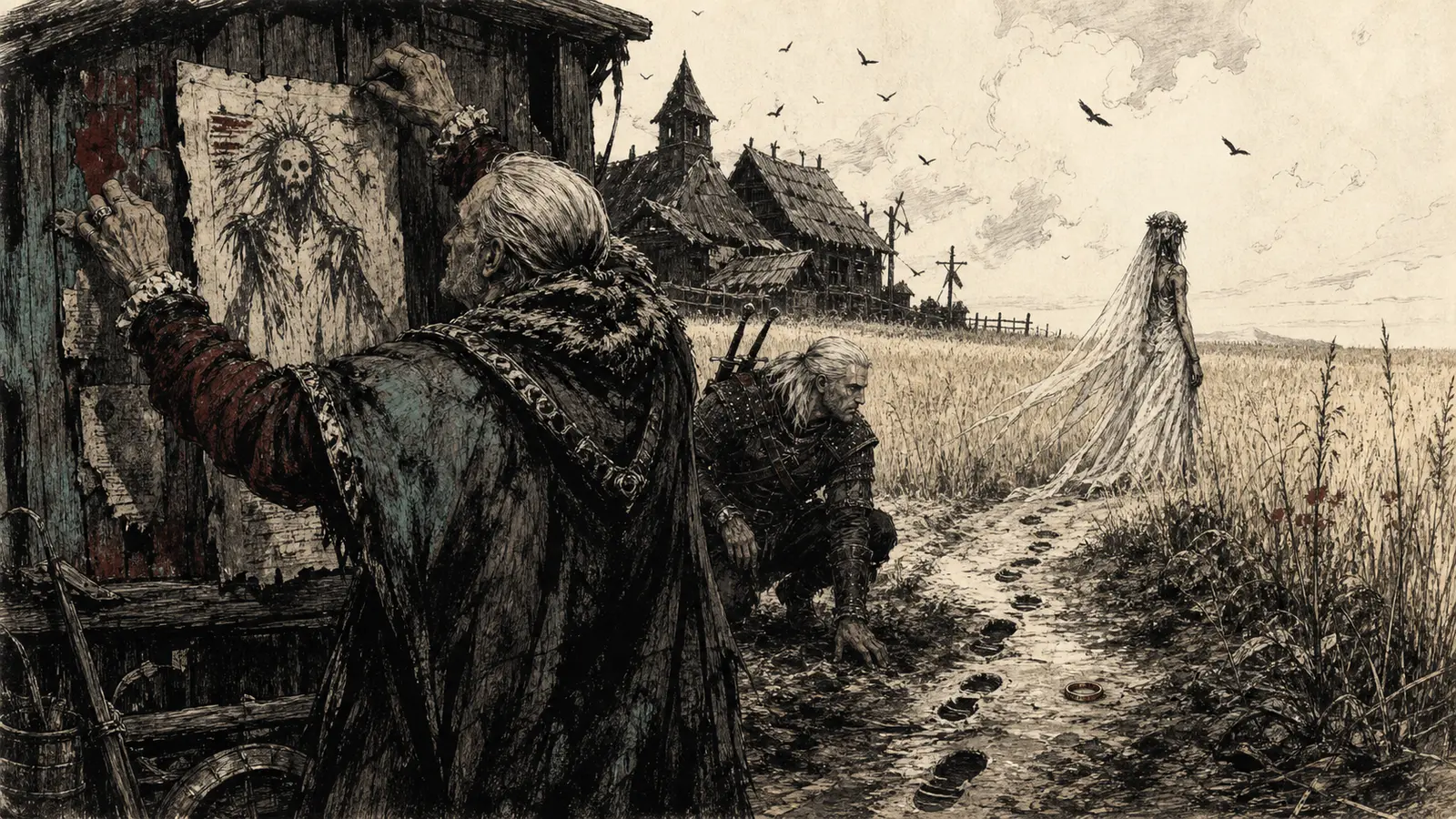
On one of those Velen days, when the rain had already stopped, but he had no intention of leaving anywhere, Geralt approached the village board and took down another advertisement. Someone is howling in the forest, someone has stolen a sheep, and recently a man has disappeared, who is now usually remembered as a good neighbor, although during his lifetime this circumstance was kept secret from him. The headman promises to pay the witcher and with all his appearance shows that the matter is completely clear.
Clarity lasts until the first questions. The tracks lead in the wrong direction, they managed to bury the body, the merchant forgot to mention the blood on his sleeve, and for some reason the woodcutters were cutting down exactly the grove where they had been advised not to go for many years. Geralt examines the ground, sniffs and leafs through the bestiary, but his main skill is revealed during conversation. He lets the customer finish to the point where he begins to contradict himself.
So the witcher's contract is gradually becoming a journalistic investigation. The monster is still hiding in the cave, but the man is already standing in front of us, demanding immediate reprisals and diligently not looking towards his own barn. People need the monster before the witcher. The witcher can still doubt and put away the silver sword. Doubt bothers people: they need a body to point to when fear is already there and the culprit has not yet been identified.
Rene Girard believed that the community relieved internal tension by finding a victim against whom it was allowed to unite. The victim must look guilty. If the crowd sees her as a random person, the sacrifice will cease to heal society and will become an ordinary murder. Therefore, the scapegoat almost inevitably acquires the characteristics of a monster. He is a stranger, unclean, dangerous and, of course, he started it all himself.
The continent is organized according to this scheme with almost municipal neatness. Each village has its own misfortune and the creature that falls to represent it. The war cannot be stopped, hunger cannot be impaled, but midday Can. After this, the world seems clear again, the headman returns to business, and the witcher receives half of what was promised.
Geralt is dangerous for such an order not with his sword. It spoils properly distributed guilt. He finds out that the curse grew out of the family, the forest monster came after the people, and the intelligent creature lived nearby for years and did not touch anyone. Sometimes he still kills the monster, but the community has already lost its innocence. Now she knows where he came from.
This is why the bestiary in The Witcher constantly ceases to be zoology. The word “monster” sounds like the name of a species, although it works like a sentence. Regis refutes it with its mere presence. O'Dimm, on the contrary, does well without claws. The most important monsters of this world do not fit on one page of the reference book, since monstrosity is determined not by the body, but by the attitude towards someone else's life.
Montaigne I noticed that everyone calls what is unusual to him barbaric. The same thing happens with monsters. Strangeness is mistaken for evil, habit for the norm, and one’s own custom for the natural structure of the world. The Witcher differs from the crowd not in his spiritual purity. He simply has to check whether the prosecution really has traces.
Evil wants to look good
In Book II of Plato's Republic, Glaucon, Plato's brother and Socrates' interlocutor, proposes an unpleasant thought experiment. Imagine a just man with a villain's reputation, and an unjust man whom everyone considers virtuous. Perfect injustice, Glaucon argues, requires more than impunity: it also wants the honour reserved for justice. If the crime comes to light, the unjust man must still be able to explain it away.
It turns out to be an accurate portrait of almost any good customer from The Witcher. True evil rarely enters a room with a confession. It offers Geralt a drink, talks about his difficult fate and chooses a word in advance, after which his own action looks like a misfortune. The family did not run away, but disappeared. People were not killed, but punished. The agreement was not violated, but it was understood differently.
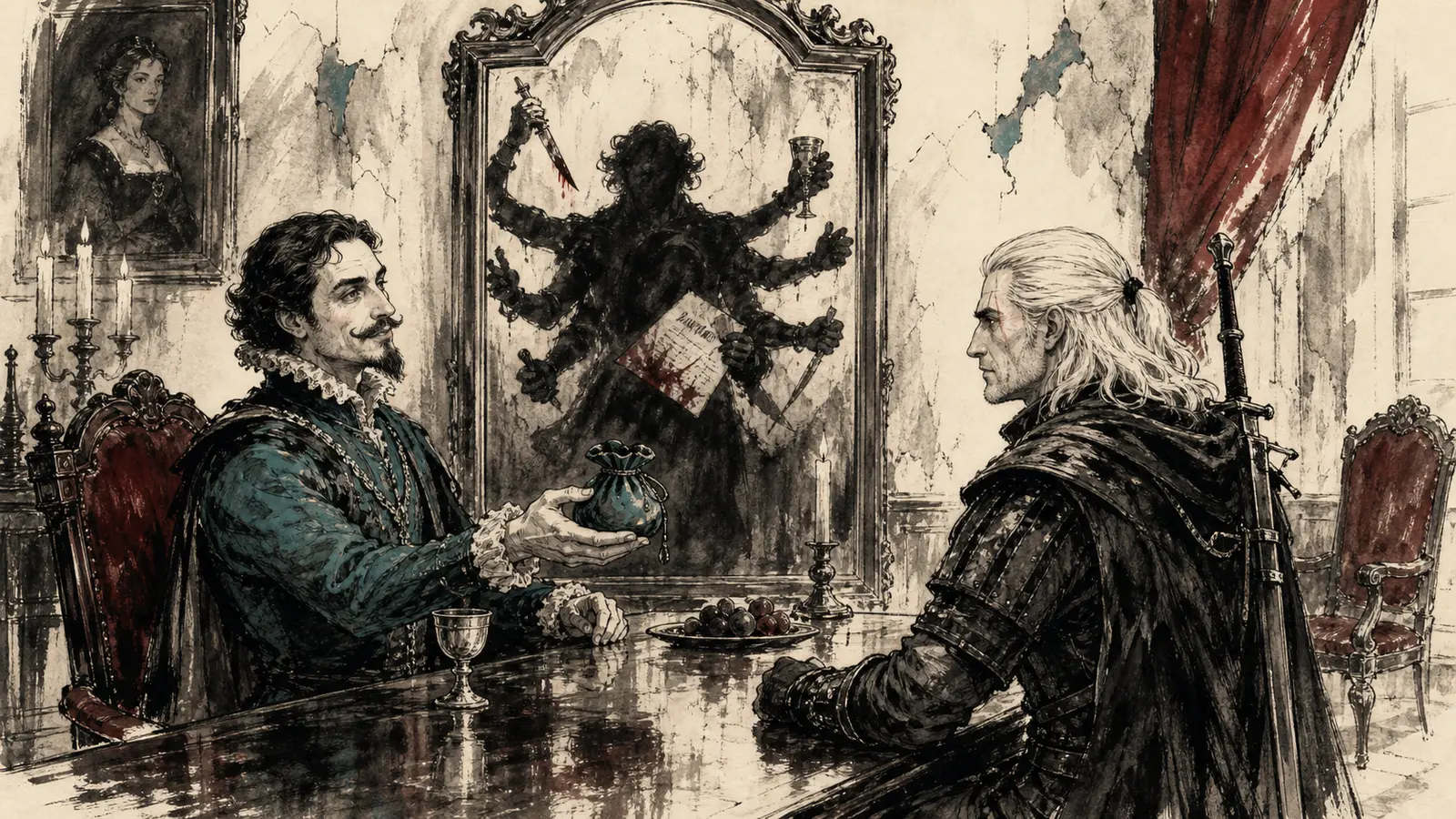
The Bloody Baron greets Geralt as a man accustomed to taking up more space in a room than he needs. He is rude, funny and knows how to win over, and his concern for Ciri overshadows everything else for some time. The Baron is looking for his wife and daughter, whom he considers missing, although they simply left.
The house tells about this before the owner. There are traces of struggle and spilled wine on the floor, and beatings, fear and pregnancy, which ends in miscarriage, gradually appear behind the family misfortune. The child was buried against the wall without a name or ceremony. Came from such a grave Igosha, looking like a baby whom someone else’s guilt managed to grow into a monster.
Geralt can kill her. This will be a difficult, but understandable battle, after which the game will give you experience and allow you to move on. The other path requires much more from the Baron. He must pick up the dead child in his arms, carry him to the doorstep, name him and bury him as a family member. Igosha then turns into a chura, a household spirit, and helps find those whose flight the father preferred to consider a mysterious disappearance.
Here the monster did not arise at the whim of forest magic. It was created by the actions of people, and therefore the sword solves only the external part of the matter. To lift the curse, the Baron has to admit the child and along with him his own guilt. Pavel Sasko, who worked on this line, said that the script was rewritten and shortened for a long time. In the finished scene there is almost nothing to explain its meaning: the Baron walks through the dark courtyard with the body of his daughter in his arms, and the player already understands that the hunt is over before meeting the monster.
Plato's point goes beyond ordinary hypocrisy. A hypocrite knows he is pretending. Perfect injustice wants more: the benefits of wrongdoing and the rewards of goodness at the same time. It is not enough for a person to achieve his goal. He wants to remain the one who will be sympathized with after this.
Kant I looked for human evil not in animal greed or in the power of passion. Passion in itself does not yet build moral order. Evil begins when a person knows the moral law, but subordinates it to selfishness. Conscience does not disappear. She is kept in the service, only transferred to the public relations department.
Many of The Witcher's monsters don't make moral choices at all. They are hungry, territorial, fearful, or tied to their own nature. A person is capable of more. He understands the norm, breaks it for his own sake, and immediately uses the same norm to justify the violation. Kant's villain does not throw away morality. He changes the order of subordination in her.
In Toussaint, Geralt meets Regis, a high vampire with the powers of a natural disaster and the manners of an old doctor. He speaks quietly, is patient with people and again helps a friend, although he is well aware of how much trouble will follow this service. In the land where knights take oaths before breakfast and break them by dinner, vampire Quite quickly he turns out to be the most well-mannered person.
His friend Dettlaff belongs to the same species and is capable of deep affection. Syanna takes advantage of this and forces him to kill and then disappears. When Dettlaff discovers the truth, understandable pain does not make him innocent. He unleashes vampires on the city and agrees to pay with the lives of others for his own humiliation.
The monster's honesty does not make him kind, and Dettlaff's sincere rage does not make Toussaint feel any better. But this rage does not try to pass itself off as a moral law. Human cruelty almost always comes with the theory that right now it is necessary.
Speechless
U Aristotle the animal has a voice and communicates pain or pleasure. A person has speech and is able to distinguish between fair and unfair. From this difference grow home and state. But there Aristotle warns that a person without virtue becomes the worst of animals. Reason does not cancel cruelty. He arms her.
The Witcher brings this warning to the everyday norm. The monster's voice communicates pain. A person's speech explains why someone else's pain should not be taken into account. The better the explanation, the less blood the speaker notices.
Hence the strange moral fascination trolls. They have poor command of human speech and therefore hardly know how to use its main privilege. The troll is capable of killing and is capable of calling murder murder. There is no corridor between deed and word through which responsibility can go to the neighboring village.
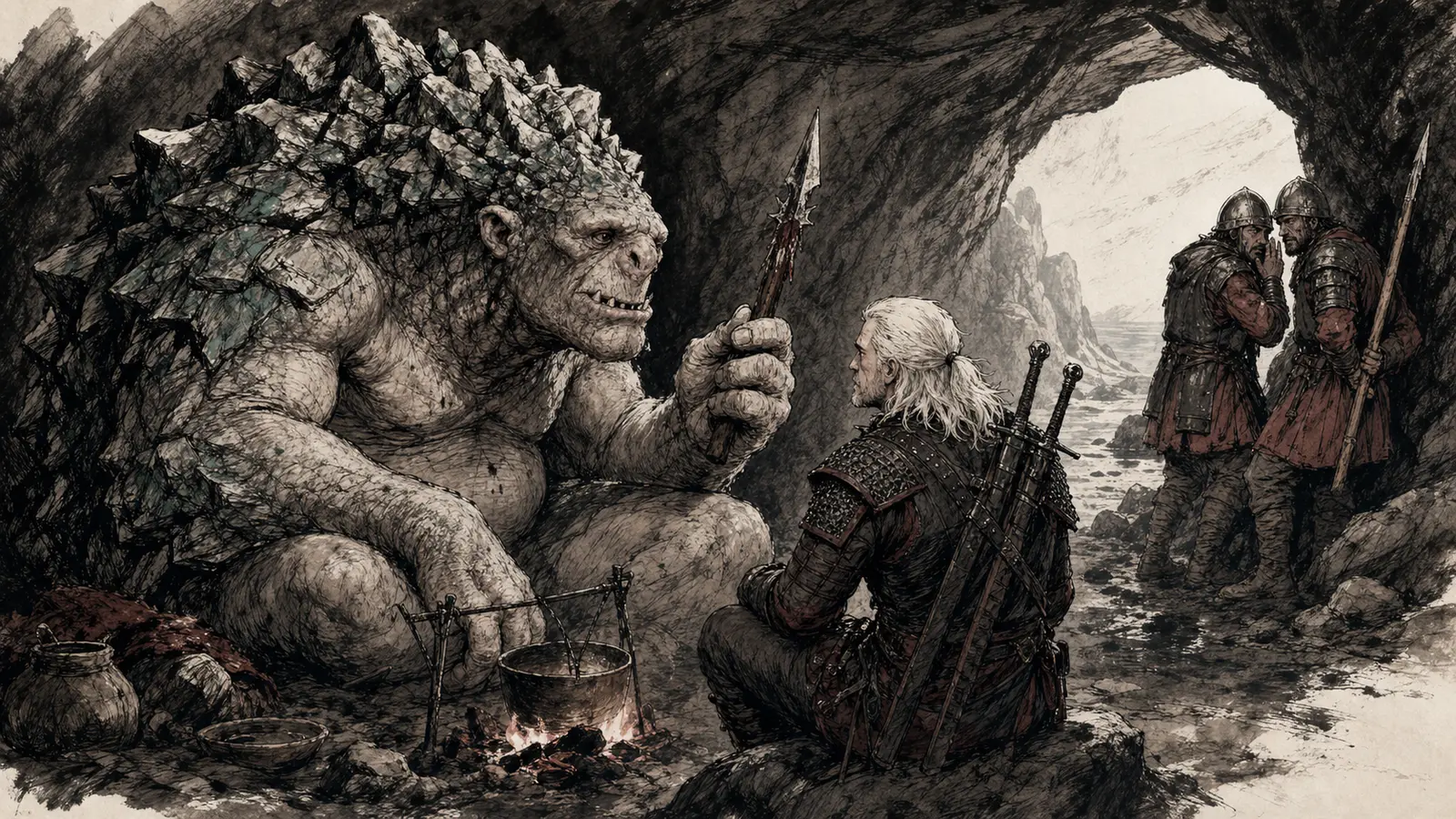
People speak incomparably better. In the village of Dobrovo, almost all the inhabitants were killed by the witcher Gaetan from the School of the Cat. He fulfilled the order, after which the employers tried to stab him to death instead of paying him. The wounded Gaetan fought back, lost control and massacred the village, sparing one girl who reminded him of his sister.
His story sounds convincing because most of it is true. Witchers are really hired, feared and deceived, and they tried to kill Gaetan. Lying nearby are people who did not participate in the assassination attempt. Geralt must decide the fate of his colleague, and the game does not help him with a neat signature on the button. Sympathy explains the action, but this does not reduce the number of corpses.
This is why Gaetan's truth is dangerous. It is easy to confuse the cause of anger with permission for everything that happened after. The Baron also does not have to lie about every event. He arranges events so that his own choice is lost between war, wine and someone else's betrayal.
Speech had to distinguish between fair and unjust. On the Continent she had learned to make this distinction around the speaker.
Freedom to be ashamed of
Sartre called a person's lie to himself a bad faith. We simultaneously consist of what happened to us and the ability to respond to what happened. Bad faith tries to destroy one half. Sometimes a person pretends that circumstances mean nothing. Much more often he portrays himself as their thing, who had no choice.
The Witcher is populated by people who willingly accept facts and do not recognize authorship. Yes, he hit, but he was drunk. Yes, I continued to kill, but I was betrayed. Yes, I signed an agreement, but did not know the price. The circumstances are real, and the game doesn’t shy away from them. War cripples. Humiliation is poisonous. Fear narrows your choices. However, no circumstance can retroactively become the hand that held the weapon.
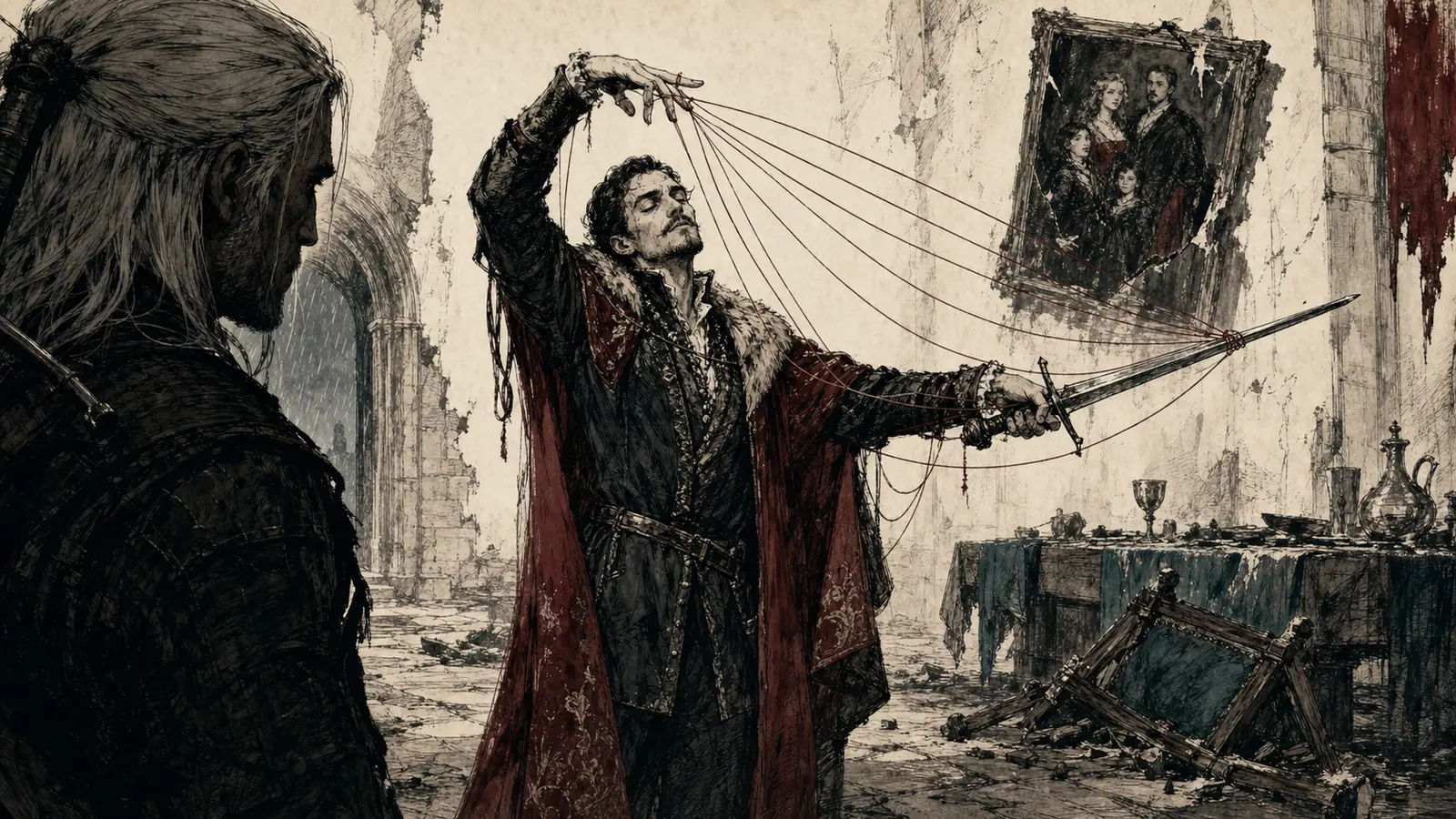
The phrase “I had no choice” is almost always said after a choice. Before him, a person doubts, bargains and looks for a way out. After it, the past suddenly straightens into a single path. Bad Faith works as an editor. She crosses out the forks.
The monster is more honest only in a narrow sense. He does not turn his nature into justifying speech. Werewolf dangerous precisely because he loses himself. A person is dangerous when he preserves himself completely, makes a decision, and then declares his own presence insignificant.
This is where the gap between man and monster lies. The monster may not be responsible for itself, since there really is no one left in it who can answer. A person first enjoys freedom, and then is embarrassed to present its consequences.
Monster with a treaty
O'Dimm stands apart because he has mastered human evil better than the people themselves. The developers deliberately left its nature without an exact name. Geralt studies an ordinary enemy, picks up oil and kills, while Mr. Mirror does not fit into the bestiary. He makes contracts, follows them to the letter to perfection, and speaks to his victims more politely than most innkeepers.
Olgierd von Everec remains human even after the treaty deprives him of his ability to feel. He lost a lot, but managed to harm others even more and concluded the agreement of his own free will. Geralt faces impeccable evil and a guilty victim, and both know how to present the case in such a way that the listener, at least for a minute, takes their side.
O'Dimm doesn't need to lie. He needs an agreement in which someone else's desire itself refuses to know its value. Kant's reversal of the moral order here becomes almost visible. Olgerd does not give up love, freedom and happiness. He wants to put them at the service of his own desire and remove from them the finitude that gives them meaning. O'Dimm is merely carrying out this grammar literally.
The contract turns evil into procedure. No one attacked from the darkness, consent was received, the conditions were met. That is why O'Dim is more terrible than the creature that can be found in the tracks. He doesn't disrupt the order. It shows that order is capable of properly serving destruction.
Here Plato's reputation, Aristotle's speech and Sartre's bad faith converge in one smile. Evil looks legitimate, speaks impeccably, and leaves the victim with the comforting thought that everything happened on its own.
Don't become a witcher
Nietzsche warned those who fight monsters about the danger of becoming a monster themselves. The quote has long been worn out to the point of an inscription above a simulator, but Geralt returns its unpleasant meaning. It is not fangs or mutation that threatens him. He's already a mutant. The danger begins when the witcher stops discriminating and becomes a serviceable continuation of the order.
Killing a creature based on an entry in the bestiary is easier than checking again who speaks, who pays, and who benefits from the word “monster.” Professionalism gradually offers moral anesthesia. There is a contract, there is a goal, there is a silver sword. The rest can be considered literature.
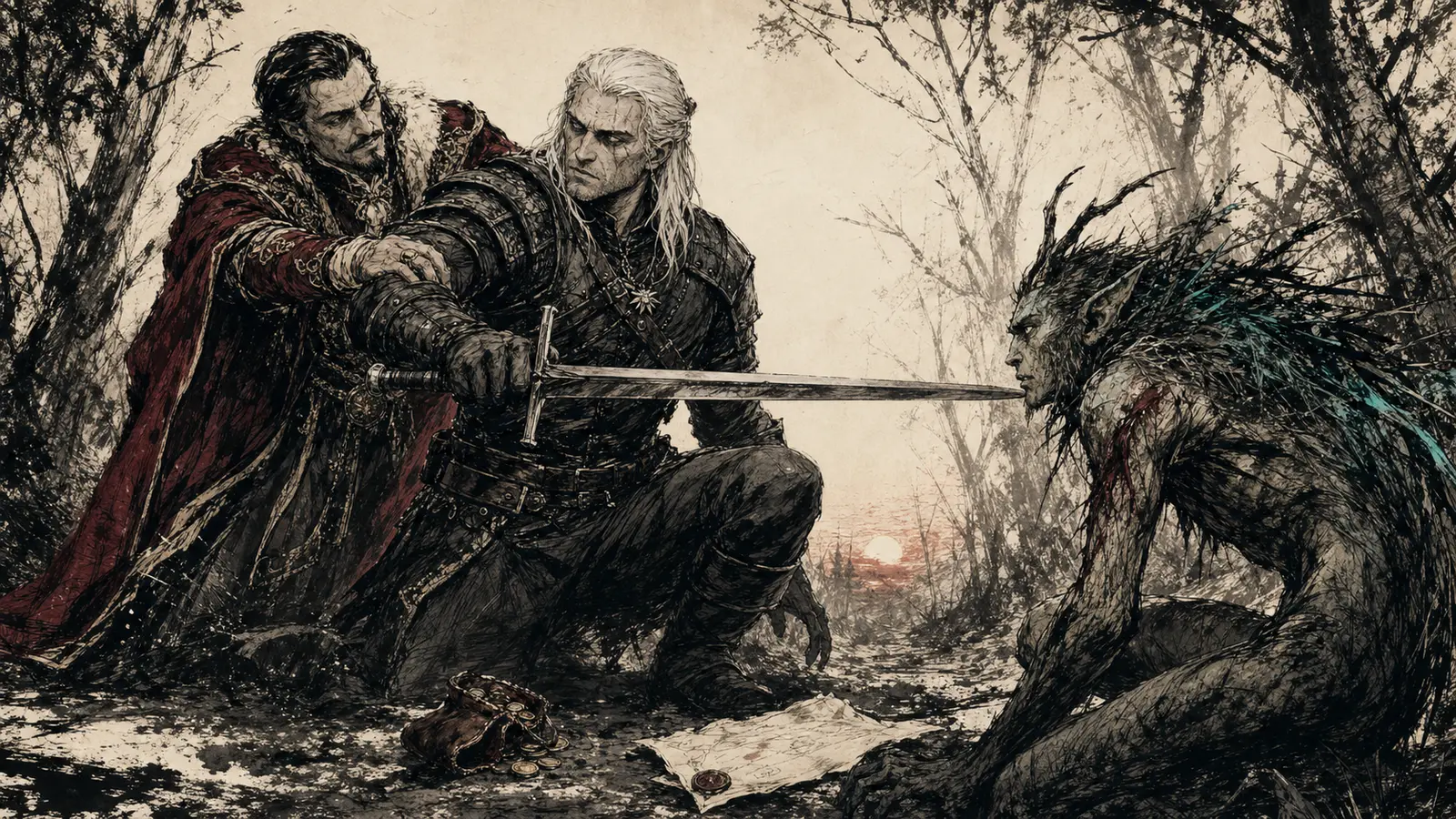
But witcher neutrality is never a lack of choice. It is rather a refusal to give one of the parties a prepaid right. Geralt is not a moralist and regularly makes mistakes, but he maintains a pause between accusation and blow. In this pause, everything human that remains in the professional killer of evil spirits lives.
The game transmits the same pause to the player. Her decisions are painful not because they hide the correct option in a particularly cunning way. They take away the opportunity to consider yourself pure after making a choice. Any button leaves damage, and then the familiar work begins. The player explains to himself why this particular damage was inevitable.
Consequences often come later than the choice itself. The spirit under Whispering Hill promises to save the children that the witches are preparing for themselves. By freeing him, Geralt does save the orphans, but dooms the village and changes the fate of the Baron's family. If the spirit dies, the inhabitants remain alive, but the children disappear.
On the first playthrough, the player listens to voices and tries to guess who is lying the least. With the second, he knows the future, but it doesn’t get any easier. The action that leads to the best outcome may require Geralt to have knowledge that he does not have at that moment. Therefore, many choose not the most favorable outcome, but the one that seems fair within the scene.
At this moment the screen becomes a mirror of bad faith. We judge the Baron for a beautiful version of the past and immediately assemble our own. We discuss Gaetan, Dettlaff or Whispering Hill, although we argue mainly about how convincingly we can justify ourselves.
That's why The Witcher survives the transition from books to games and to the screen. The monsters change along with the graphics budget, but the human mechanics remain the same. First we create a culprit, then we inflict the necessary evil on him, then we ask the storyteller to arrange everything so that a good person returns home.