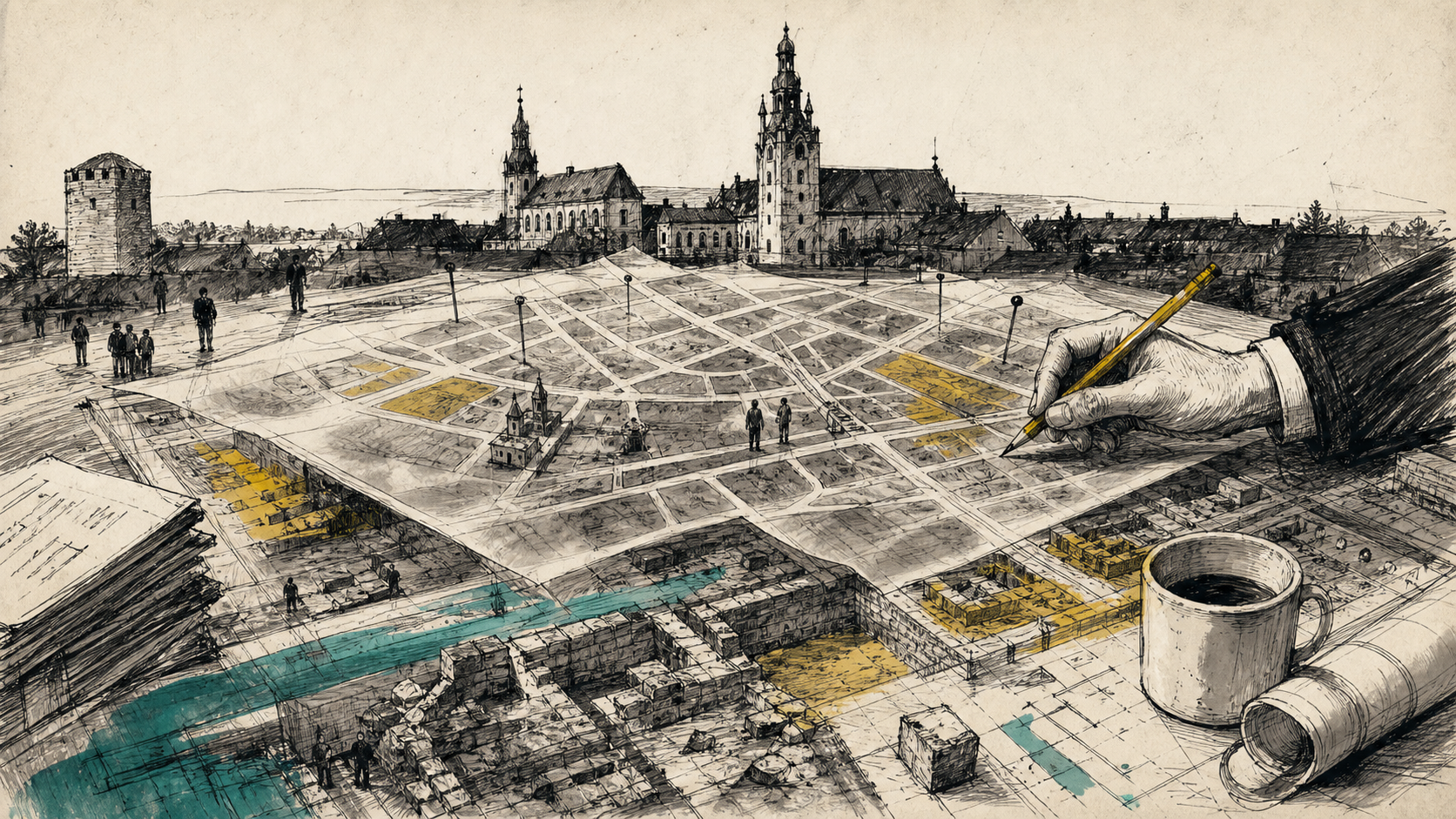
Narva is again trying to pretend that it has an old city.
Not in a tourist sense. Not in the format of a sign, lighting and a cautious sigh: “Europe could be here.” But for real. With land, courtyards, fire access routes, archeology, owners and people who did not order historical justice for themselves with a cadastral application.
We are talking about the area around Rüütli, Vahe, Pagari, Rahu, Suur and Pimeaia. The city has been working on a plan for years that should bring the old street logic back to the center. Not a copy of Narva before the war. Not a plywood postcard. Not an open-air museum where everyone should walk nicely and not touch with their hands.
Something more difficult.
A new quarter that remembers where the city used to have streets.
The idea is good. Almost too good for a place where every good idea starts to argue with parking after twenty minutes.
The street remembers itself
On paper, everything looks almost convincing.
Rüütli should become pedestrian or almost pedestrian. The neighboring streets are quieter. The car there is no longer the head of the district, but a participant in the crowd. The facades keep the line. The windows remember the rhythm. The roofs don't scream. The first floor is trying not to die even in the drawing.
The city specifically says: this is not “the way it was.” Nobody promises the atmosphere of the forties. Old photographs and drawings are needed not to build yesterday, but to avoid building another tomorrow without memory.
This is where a good idea first begins to creak on the asphalt.
And then it comes into the yard
Reality begins on Suur 12.
No historical fabric lives there. A house does. A yard. Cars. Greenery. People who know where the sun is, where the puddle is, where the neighbor usually parks the car and where it is better not to go in winter.
And then comes the plan. And he says: hello, I’m a street. I haven't been here for a long time, but actually I'm back.
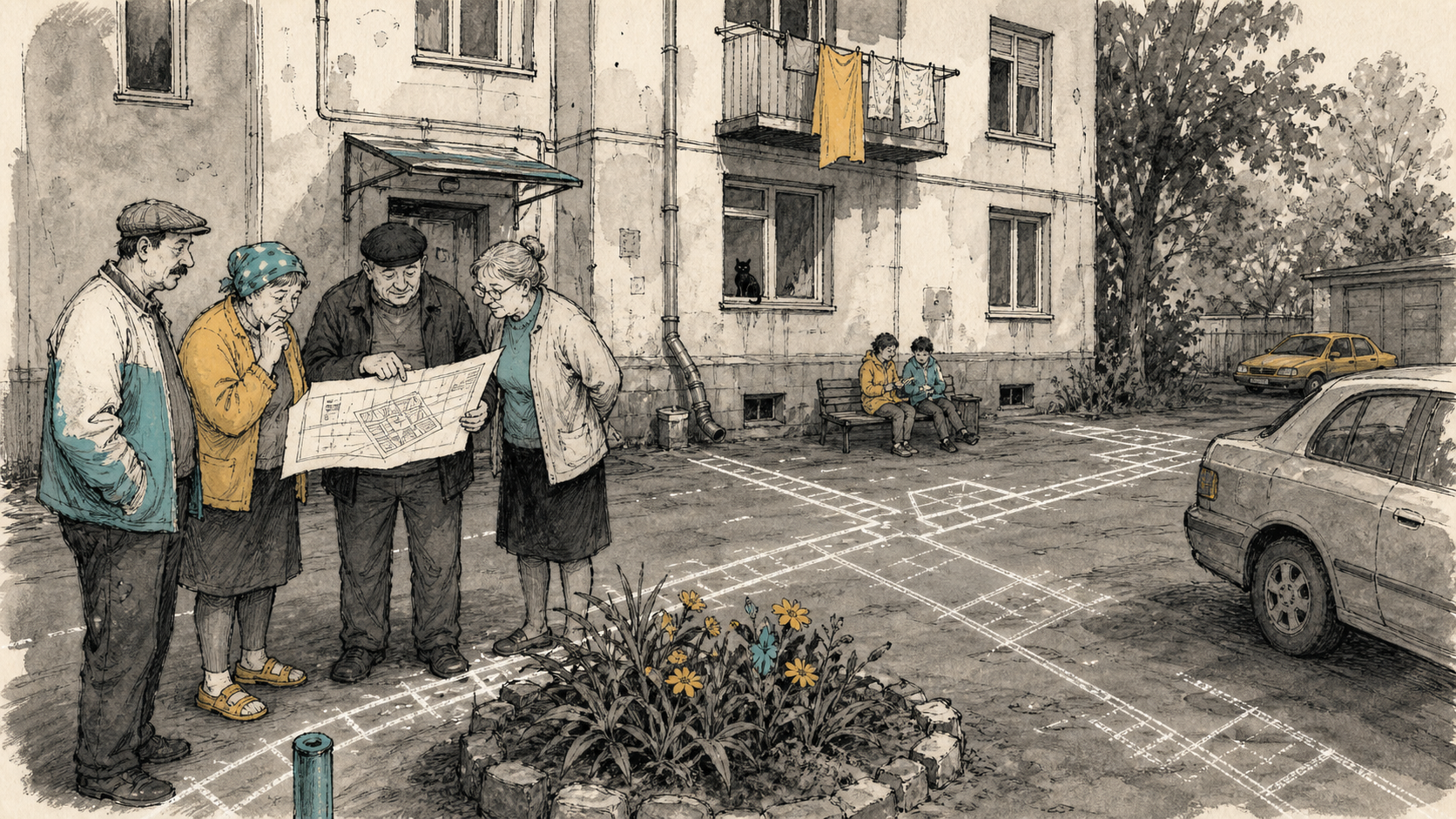
Residents are not asking about philosophy. They question life. What will happen to the house? The yard? The passage? Fire access? Who will use the land and how? Why does the word “easement” again sound like someone is about to walk, politely, through the wrong door?
The city responds: the property does not disappear, the boundaries are not rewritten in one paragraph, the house remains, the procedures will be separate.
Formally it sounds calm.
But between “formally calm” and “we’ll change your life a little” lies a whole yard. With a bench, a flower garden and a man who has already seen enough reforms not to rejoice at the word “prospect”.
A good idea comes to a living place and finds that the place can also speak.
Pimeaia 12: the future with roulette
Separate nerve - Pimeaia 12.
There, the story will not fit into a handsome folder. The site sits where the new street, land, Liivavall, archeology and private interest begin to look at each other without much love.
The city sees structure.
The owner sees the land.
Archeology sees the past.
The most Narva moment of any large layout.
This is real urban drama. Not when the render shows the wrong shade of plaster. And when a good idea comes to a living place and finds that the place can also speak.
There's also a queue underground
The most stubborn participant in this story is generally silent. It lies underground.
Old foundations, basements, street lines, fortifications, Liivavall. All the details that sound lovely in a presentation and misbehave around an excavator.
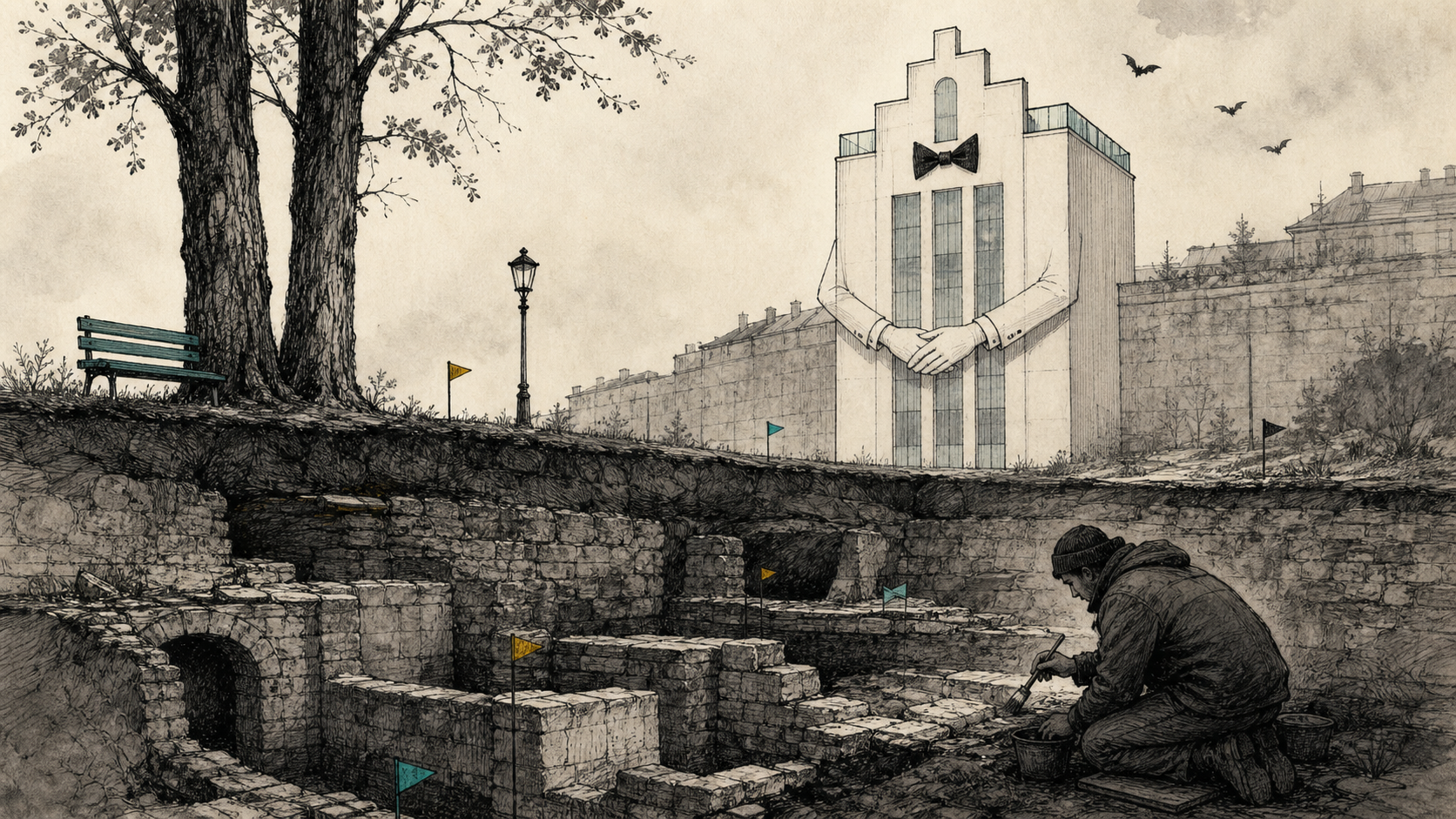
In Narva, the past is not a background. Not a postcard. Not a word for grant. It lies under your feet and from time to time says: sorry, I’m here before you.
This slows building down.
But it keeps you from building foolishly.
There's also a park there
And the park is not alone.
There are trees, security logic, bats, a gray owl, officials, property owners, firefighters, archaeologists, dreamers, potential investors and a person who wanted to park a car in the evening.
If this were a men's magazine, it would call this set "the perfect balance of strength and character."
NARVAL calls it Tuesday.
We need dreamers too
It's easy to laugh at people who want Old Narva back.
Too easy.
Because without such people the city would have long ago finally agreed to be an empty place with a good view of the past. They keep more than the façade in mind. They hold the opportunity. The centre could be denser. More alive. Not drive through, park and leave. And go out, stay, meet, go inside.
It's not a bad dream.
It becomes bad only when it begins to forget that today someone already lives in the place of the dream.
“As it was” is no more. There are documents, security conditions, courtyards, fire requirements, archeology and people not from archival photography.
Old Narva as an idea is wonderful.
Old Narva as a procedure is a psychological thriller with a municipal font.
A dream becomes bad when it forgets that someone already lives in its place.
Why is this important
Because this is more than planning.
This is a test: can Narva regain its center and not turn living people into an appendix to a beautiful idea.
Old Narva is a strong myth. Necessary. Saving in places. But myth loves a clean line. And the city lives on a dirty line. Where is whose land? Who clears the snow? Where is the fire truck going? Where is the neighbor? What was found underground? Who pays? Who will then live on the first floor? Why can’t you make it beautiful?
You can say “historical fabric” as much as you like. But one day this fabric comes into the yard and says: hello. I'm a street.
I've been gone for eighty years.
I'm back.
And a person has the right to ask:
Are you sure you're coming to me?
What's next
Next will be the most Narva thing: the coordination of reality with reality.
A good scenario is if the city holds both sides. He will not betray the idea of Old Narva. And he won’t sell it like someone else’s dream through someone else’s yard.
We also know the bad scenario. A folder with a beautiful name. Years of correspondence. Tired officials. Offended people. An investor who is “still watching.” And the wasteland, which again defeated everyone by refusing to hurry.
Narva is trying to bring back a street that has been gone for a long time.
Almost a wonderful task.
The main thing is that along the way it does not turn out that the city knows how to restore the past, but again has not come to an agreement with the present.