
Advertising has an unpleasant property: it comes into the world without its author. On the phone screen, at a bus stop, in a neighbor’s chat feed, she doesn’t have time to unfold the presentation, show a slide with good intentions and ask to watch to the end. The person sees the first frame. Sometimes - one phrase. This is what becomes advertising.
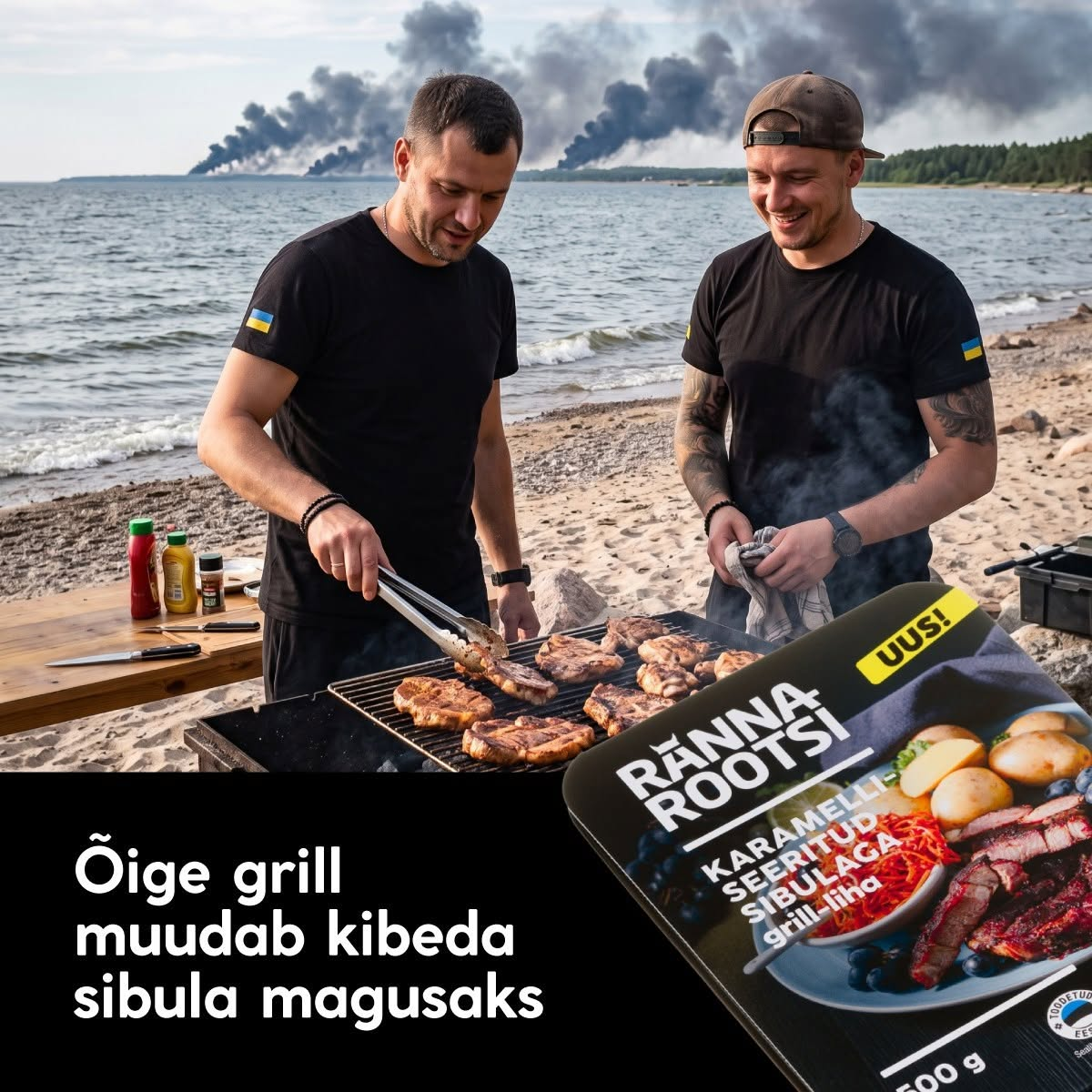
In July 2026, Estonian meat producer Rannarootsi learned this lesson in a particularly concentrated form. On the beach, two men in T-shirts with Ukrainian flags are grilling meat; Thick smoke rises behind the water; Below is a package of grilled meat with caramelized onions. The tagline promises that “the right grill makes bitter onions sweet.” The company explained to ERR that it was about the product and its ingredient, not about politics. But by the time of explanation, the image had already been read through the war, the smoke and the context of the word “onion” in Estonian public speech.
This does not mean that a hidden agenda should automatically be attributed to every failed campaign. On the contrary: editorial analysis begins by separating three things. What the authors wanted to say. Which was literally shown. And what did the audience see, which is not obliged to know the internal logic of the brand. In contentious campaigns, these three layers are often at odds. The more they disagree, the more expensive the “bold move” is.
Not a scandal, but a translation failure
Companies like to explain conflict with the word “misunderstood.” Sometimes this is true: the audience does construct meaning from their own experiences. But this does not relieve advertising from responsibility. A poster that only works after a verbal explanation from the author is doing a poor job. His task is to translate the meaning, and not to create a riddle, which the press service will then decipher.
Such stories almost always have the same mechanism. A brand takes a powerful social symbol—war, national divide, gender inequality, religious symbol—and connects it to a product. Within a team, the connection may seem obvious. From the outside, the viewer first sees a heavy sign, and only then a sausage, a party logo or a scholarship. The proportion of attention breaks down: the subject of the campaign becomes a footnote to the stimulus.
01. Rannarootsi: the subpoena ate the goods
Translation: “Proper grilling makes bitter onions sweet.”
The product idea itself is clear: the marinade contains caramelized onions, and the grill is supposed to turn the bitterness into sweetness. The problem starts with the visual design. Smoke on the horizon, Ukrainian flags on the sleeves and a beach scene do not work as a neutral background. They give the image news temperature. After this, the product no longer guides reading - it ends up at the bottom of the frame, literally and semantically.
The key word here is sibul, in Estonian “onion”. In certain colloquial contexts, this is a disparaging nickname for Russian-speaking residents of Estonia; this is the value ERR pointed out when describing the response to the ad. Inside the bag, the word identifies the ingredient. Next to Ukrainian symbols and smoke, it can already be read as an ethnic marker. Therefore, the dispute was not about whether onions have bitterness, but about who in this phrase turns out to be the “bitter onion” and who gets the right to make it “sweet.”
The public mistook the combination of an offensive ethnic nickname, Ukrainian symbols and smoke on the horizon for a deliberate hype on blood and war. Editorial assessment of NARVAL: he almost certainly is. Not because we have minutes of the meeting with a written plan - we don’t - but because too many politically charged details are collected in one advertising frame and they work too accurately for conflict. The version of an innocent coincidence requires much more trust from the viewer than the advertising itself has managed to earn.
Rannarootsi chose an explanation rather than a disappearance: a company representative told ERR that there was no political or hostile message intended and that an alternative reading was discovered after publication. This is a soft form of damage control: don’t argue with what hurt people, but maintain the original intent. At the time of writing, no reliable public data was found on the withdrawal of the campaign, boycott, drop in sales or personnel decisions. The campaign is too fresh to turn the noise into a financial conclusion. This is an important discipline: resonance in comments is not the same as measurable damage to the brand.
However, even without numbers you can see the organizational cost. Now the company has to answer not about the taste of meat, but about war, national markers and the limits of acceptable irony. The summons ate the goods. For a small local brand, this is already a loss of attention: editorial time, executive comments and reputational tail are spent on explaining what should have been regular seasonal advertising.
02. Eesti 200: the mirror has become a door
Translation: “There are only Estonians here / There are only Russians here.”
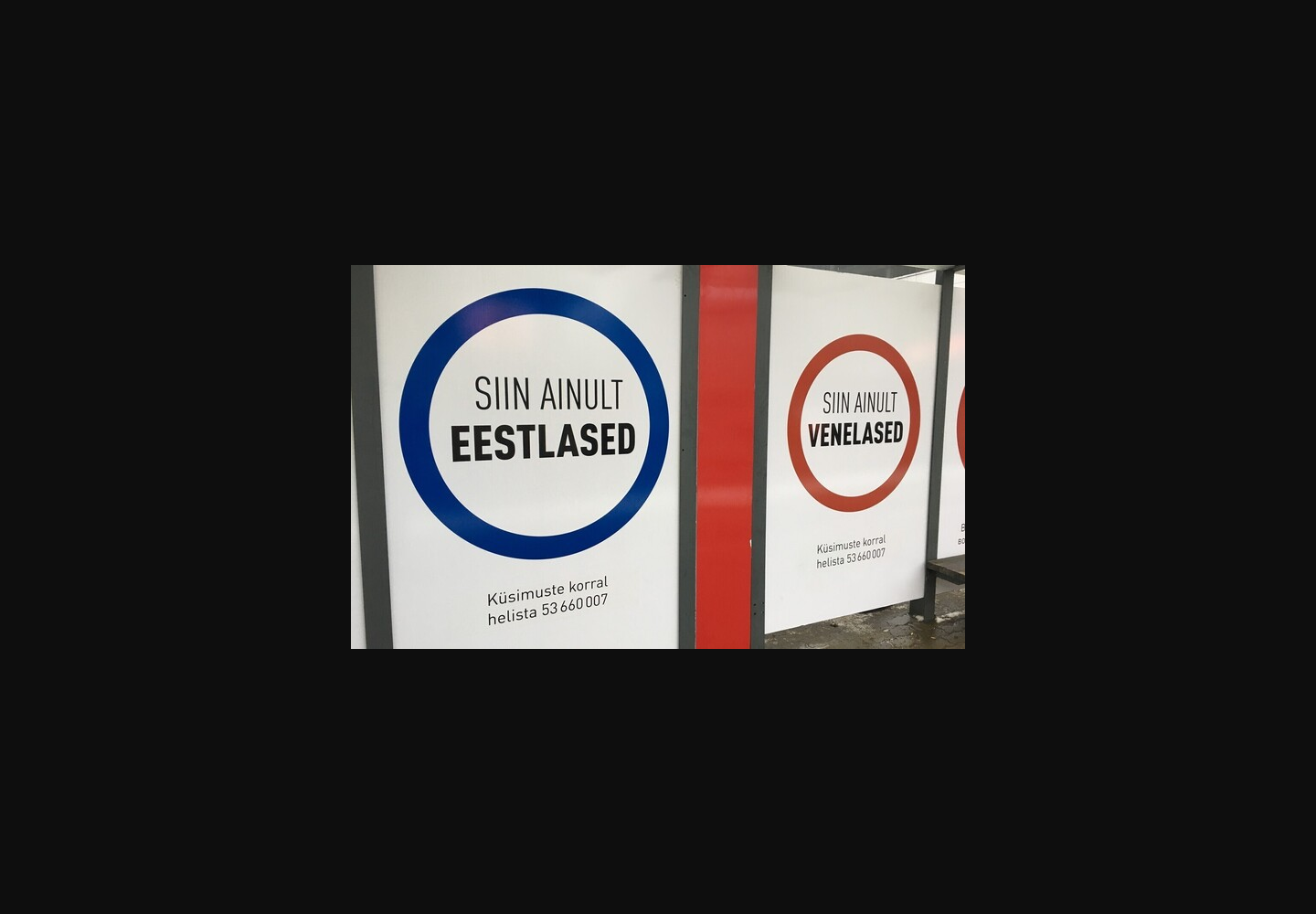
The concept of Eesti 200 was structured in two steps: first to show the division, then to reveal that it is a criticism of the division. But outdoor advertising is not a lecture or a video with a mandatory second scene. The first poster existed independently. It sounded like a ban, not a commentary on the ban. When it was replaced by a message about a common school and a common policy, the logic became clearer, but the first impression had already managed to live its own life.
Here the consequences can be seen better. ERR wrote that the director of the Integration Foundation, Irene Käosaar, left Eesti 200 after the action. This is not a dismissal, but the public departure of a person associated with the topic of integration - that is, a particularly sensitive organizational cost. Later, ERR itself, in retrospect, called the posters a major mistake: many did not understand the intent, and the damage had already been done. A Norstat poll conducted during the days of the scandal recorded party support at 2 percent; before that, in the same month, it was above the electoral threshold. This is a strong signal, but not proof of causation: one measurement is not able to separate the effect of posters from the entire election dynamics.
In the 2019 Riigikogu elections, Eesti 200 received 4.4 percent of the votes and did not cross the 5% electoral threshold. Attributing the entire result to one stop would be newspaper magic: the party had other problems, and later it returned to big politics. But the case shows what hard damage control looks like without a beautiful ending. The posters were quickly replaced, the meaning was explained, but the symbolic score still came - in trust, internal conflict and the need to remember this episode for years as one’s own mistake.
03. Burger King: the first line is stronger than the scholarship
Translation: “Women belong in the kitchen.”
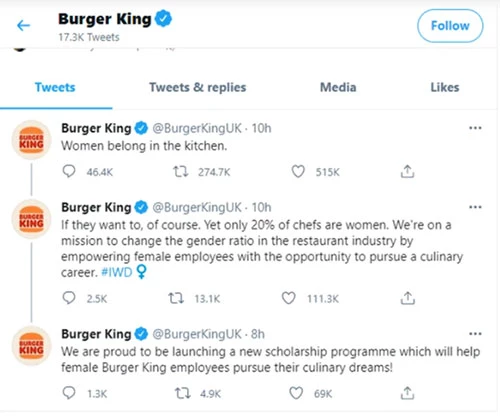
Burger King UK launched the campaign on International Women's Day. The provocative first line was followed by a normal corporate story: the chain wrote that only about 20 percent of chefs in the UK are women, and promised a scholarship program for female employees. The error was not in the program itself. The mistake is in assuming that on social media the public will read the thread as a script and patiently wait for the third tweet.
This is not how the social network reads. She cuts out the beginning, transfers it to other people’s feeds, puts it next to other people’s experiences and sends it on. The first line of Burger King turned out to be not a “conversation hook”, but a ready-made independent statement. In the BrandTotal monitoring, which was cited by the industry publication Meio & Mensagem, of more than 251 mentions, 71 percent had a negative tone. This is not reputation accounting or global sales statistics, but a sufficient photograph of the first day: the campaign lost to its own headline.
Damage control developed along a classic, but imperfect trajectory. At first, the account tried to explain why the provocation was needed. The company then admitted that it had made a mistake with the first tweet, deleted it and explained that the replies included many insults. At the same time, the scholarship initiative itself was not canceled: Burger King retained the useful part of the campaign, but removed the toxic entry into it. Open, reliable sources found no confirmation of layoffs of employees or agencies because of this story, nor any published data on a drop in sales that could be attributed specifically to the thread. This does not mean that there was no damage; this means that it cannot be invented by the number of retweets.
The most unpleasant effect here is the archival one. Even after deletion, the screenshot of the first phrase continued to live, and the attempt to delete it itself became part of the plot. In digital advertising, deletion is often necessary, but never returns the campaign to point zero. It changes the question from “what did they say?” to “why did they say it and then take it away?”
04. Benetton: reach does not equal box office
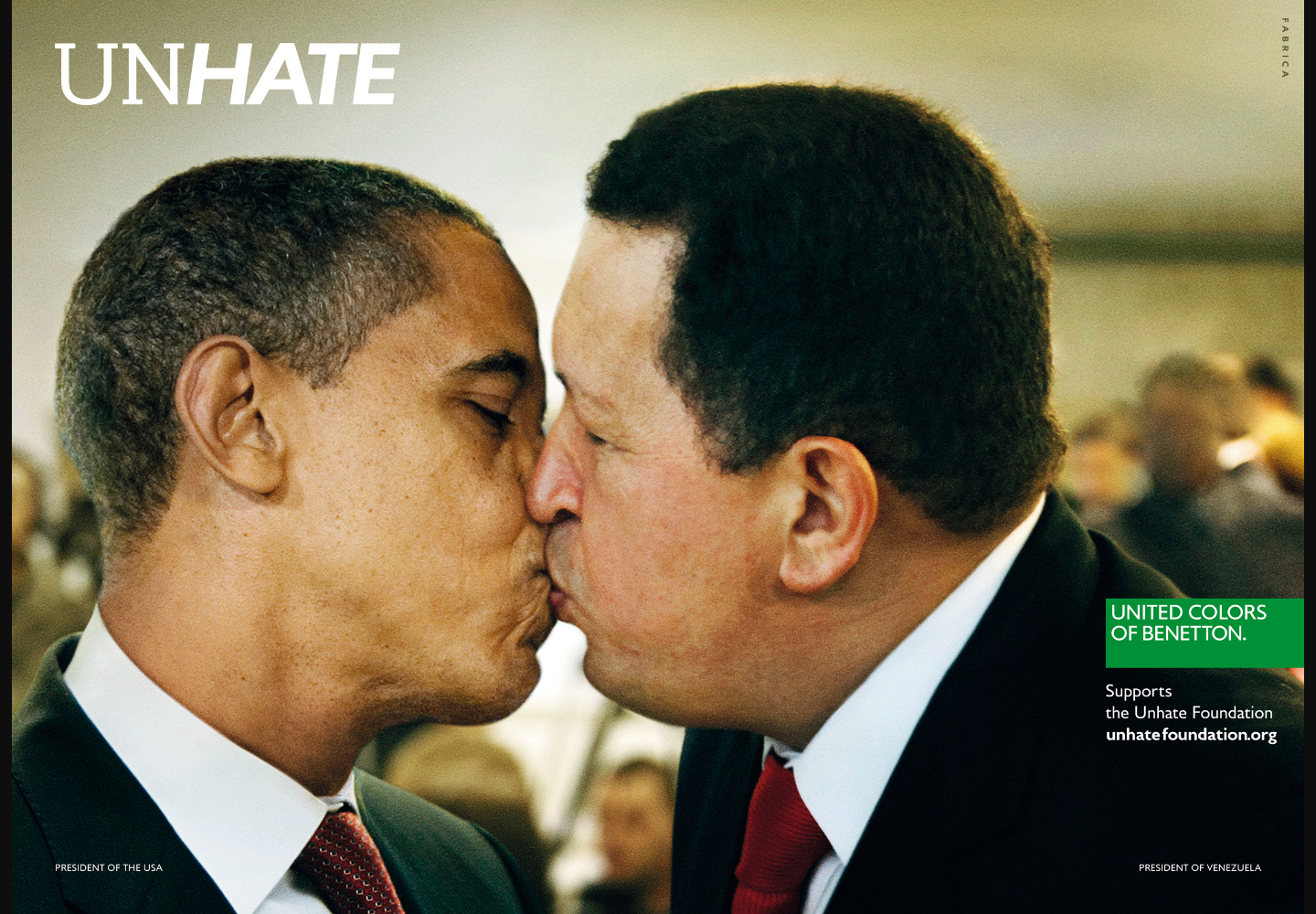
Benetton did not enter this zone by accident. Scandalous campaigns had been part of his brand long before UNHATE, so the provocation did not seem like a sudden stunt in a foreign genre. In 2011, the company featured world leaders and religious figures in edited kisses. The most controversial image turned out to be the image of Pope Benedict XVI and Ahmed Mohamed al-Tayeb, the Supreme Imam of Cairo's Al-Azhar University: after a protest from the Vatican, Benetton quickly withdrew this poster and apologized to the believers.
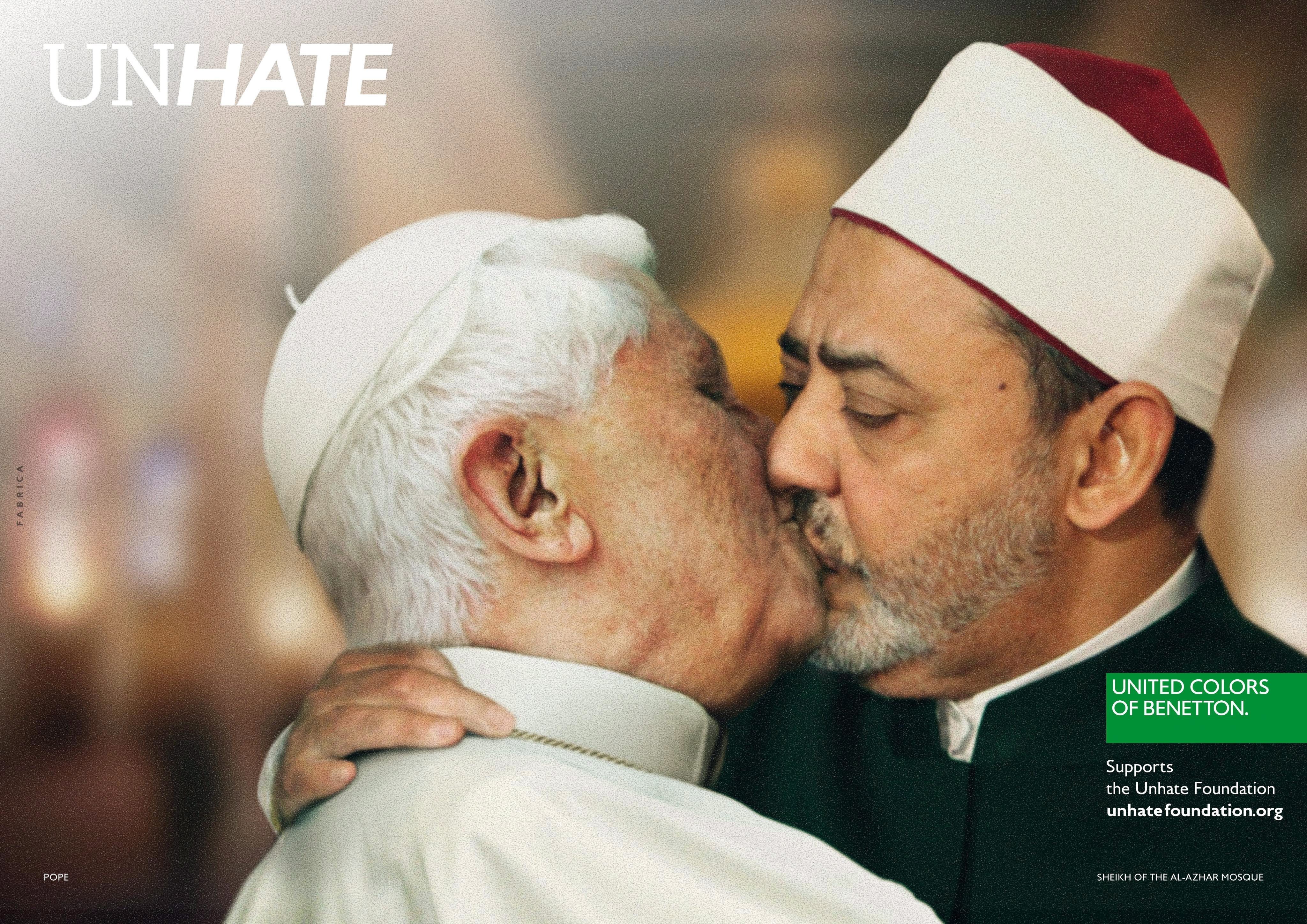
This is an example of a different type of damage control. The company neither scrapped the campaign's entire language nor pretended that the public had misread it. Instead, it contained the damage: the offending image came down, while the UNHATE framework remained and became associated with the Unhate Foundation. That is, the brand recognized the boundary of a particular institution, but did not abandon the reputation of a brand that consciously works with conflict.
This choice had double the price. According to a Campaign retrospective, the story became one of the most talked about on Twitter, and Benetton's Facebook following grew by about 60 percent; in 2012 UNHATE received the Press Grand Prix at Cannes Lions. But fame and bonuses are not financial statements. The same retrospective noted that Benetton's business continued to decline slowly, and no one could convincingly prove a direct commercial victory for the campaign. Open sources give no reason to talk about layoffs due to UNHATE. This case is not about scandal selling. It's about how cultural capital, media reach and box office are three different currencies.
What exactly do companies lose?
Loud advertising almost always promises coverage. But reach is simply the number of eyes, not agreement, liking or purchasing. It is more useful to count the consequences on four different accounts. Otherwise, a meme, a dismissal, a drop in ratings, and a dispute under a post will all be lumped together—things of different scales and different evidence.
- Attention. The scandal makes the campaign visible. The only question is whether after a day they remember the product or just a replica that they want to forward to a friend.
- Trust. If the audience perceives cynicism or carelessness in the campaign, they will find it difficult to believe the following explanation. Especially when the brand came to talk about equality, war or dignity.
- Internal price. Sometimes it is visible right away: Irene Käosaar’s departure from Eesti 200. More often it remains behind the scenes: lawyers’ hours, SMM teams, negotiations with partners, the need to explain to employees.
- Measurable result. It cannot be replaced by the mood of the tape. It requires sales, surveys, partner refusals, dynamics of reputation metrics or confirmed personnel decisions. If there is no data, an honest analysis says so: there is no data.
Five questions before publication
- What does a person see without a briefing? Show the first frame to someone who doesn't know the brand and doesn't have to guess the irony. Ask not “what did the author want to say?”, but “what is said here?”
- Has the public sign become a decoration? War, discrimination, religion and trauma do not automatically strengthen a product. The less direct the connection with the product, the more likely it is that the sign will be stronger than the brand.
- Does meaning live without continuation? If a second card, third tweet or clarification in the comments is necessary to remove the insult, then the first screen has already been played.
- Who will speak tomorrow. Before launching, you need to decide who is responsible, what facts they support, and where the line is between explanation, apology, removal of material, and defense of the creative decision.
- What data will show the real effect. Agree in advance what you will measure: sales, support requests, audience mood, partner reaction. Otherwise, after the scandal, there will only be a dispute about “it was a lot or a little.”
- ERR: Rannarootsi about scandalous advertising
- ERR: Eesti 200 posters, care of Irene Käosaar And party retrospective
- Norstat / Ühiskonnauuringute Instituut: survey after posters
- The Washington Post: Burger King UK And Meio & Mensagem: thread and monitoring
- Benetton Group: UNHATE, RTVE: layout review, The Guardian: Vatican reaction And Campaign: retrospective
All images are either provided to the editors or are shown as screenshots of original materials with the source indicated. Impact estimates are separated from verified facts: the absence of public data does not mean the absence of harm.