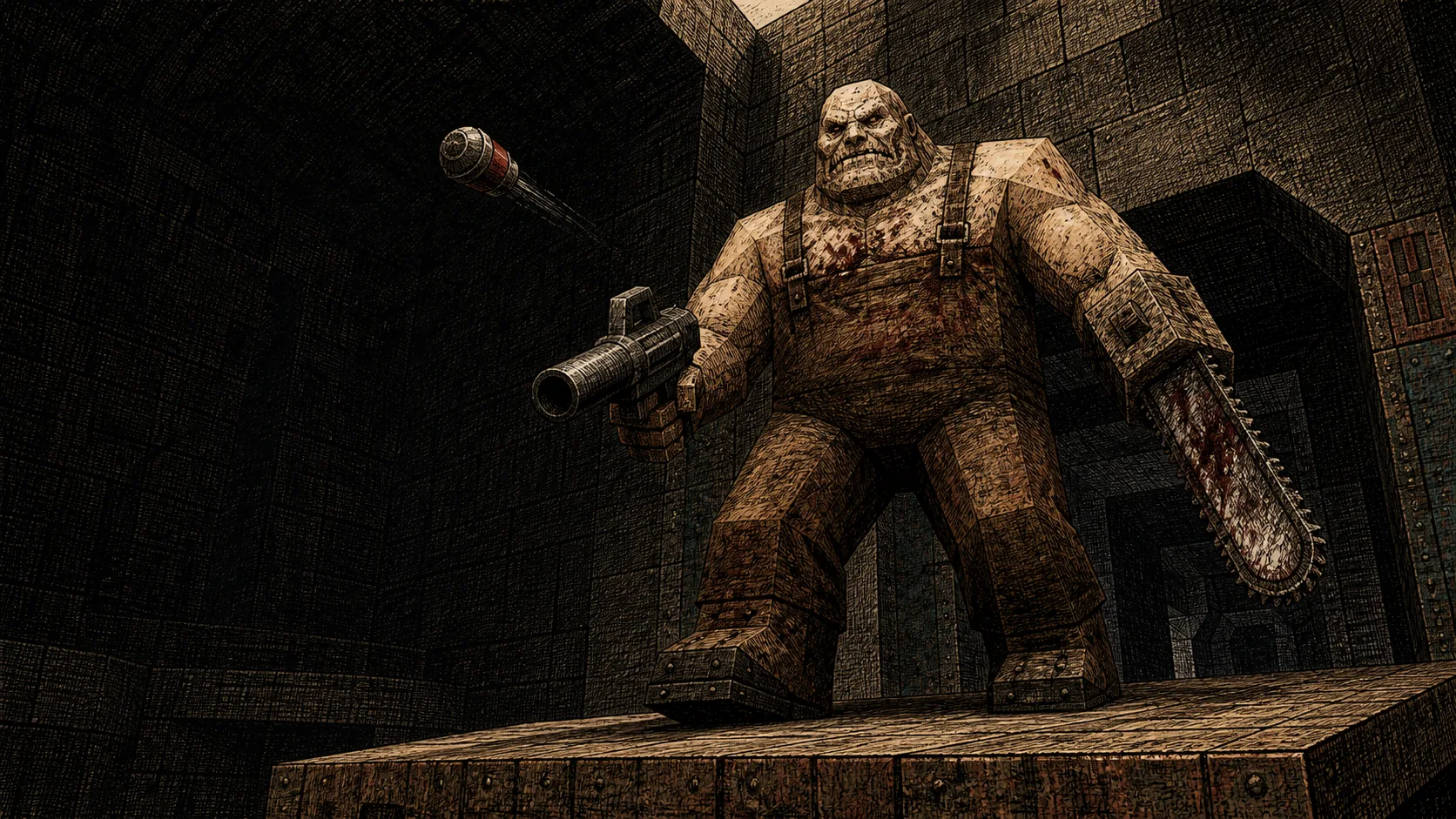

On June 22, 1996, a shareware version was released Quake. This was the part of the game that was allowed to be copied and passed on: the early Internet was slow, but school corridors, floppy disks and friends with a CD-ROM drive were able to deliver new items almost flawlessly. The full version reached customers later, but even then it was clear: id Software released not just another shooter.
In Quake, there was no cinematic hero with trauma, moral choices, and a face to be seen in a cutscene. There was an unnamed Ranger, a shotgun, a nail gun, an axe, and several dimensions populated by knights, ogres, and creatures best left unnamed before dinner. The plot explained only the main thing: we must move on. This was considered motivation enough in 1996, and in truth, it often remains the best.
Thirty years later, the game looks less like a museum piece and more like a harsh test of taste. If in the first ten minutes you want to turn it off due to the lack of markers, a skill tree and a person who confirms every twenty seconds that you are great, then Quake has simply made clear which services it refuses to provide.
Not the “first 3D”, but the first time walls became real
Say that Quake “introduced three-dimensionality” is not entirely accurate. 3D games have existed before, and Doom has already convinced half the world that you can live in the corridors with a first-person view. But its levels were a tricky flat decoration: the rooms could look voluminous, but one could not stand directly on top of the other.
Quake changed the very design of space. In its engine, walls, stairs, bridges and rooms were real 3D geometry. Therefore, the map ceased to be a drawn labyrinth and became a place where you can look up, down and realize that the enemy is already jumping on your head. The camera moved smoothly, the mouse ceased to be an accessory to the keyboard, and the heavy Pentium suddenly turned out to be a device that also needed an expensive 3D card.
The game required almost as much from the computer as it did from the player. It was annoying, but that's why Quake helped sell the first 3D accelerators: people bought hardware not for spreadsheets and accounting, but so that stone corridors would stop turning into a slide show when meeting ogres.
Shooting as a programming language
Quake's main achievement went beyond graphics. id Software left the players with QuakeC, the language in which the game logic was written. The level, monster, weapon and match rule are no longer sealed inside the box. They could be changed, reassembled and shared with others.
So, not just an audience, but a production team was formed around the game. Some drew maps, others made models and mods, others ran servers, others recorded playthroughs and analyzed them frame by frame: how a player completes a level faster than seems possible. Later, source ports appeared: they allowed the old game to live on new systems without turning it into a digital scarecrow under glass.
The network mode also turned out to be a separate school. The original multiplayer was fast, jumpy, and didn't play well on regular modems. The QuakeWorld update reduced the impact of latency and made dueling easier to understand for those who didn't consider enemy teleportation a natural feature of a phone line. From this culture grew eSports matches, demo recordings, and the habit of watching a player complete a level faster than seems possible.
Krenholm is like a map that didn’t have time to be completed
Quake has a distinctive architectural language: rough stone, iron, water, pipes, dark passages and a sudden hall, where the world seemed to be built not by people, but by a tired cult with a good budget for masonry. In Narva this intonation has one obvious relative - Krenholm. Not because the factory literally looks like a game, but because both spaces force you to look at the scale and immediately ask: “Where to next?”
A gift that didn't turn into a season pass
This year's anniversary came a little late. On August 6, at QuakeCon, id Software and MachineGames released a free chapter Dawn of the Machine. This is not a remake or a promise to someday revive the series. These are 19 new levels for the updated version Quake, made by a team that has already added to it Dimension of the Past And Dimension of the Machine.
In the new chapter, Ranger finds himself in a dimension of endless illusions. He was given two new tools: a Super Ax with electric attacks and a Laser Cannon with ricocheting projectiles. Along with the levels, the update added the id Vault - an archive of development materials, including early unfinished maps. This is a rare gesture for the industry: instead of explaining why the old game should be bought again, the developers put new rooms in it and allowed us to delve into the drafts.
On Reddit, the reaction was almost touching for a community that has been debating the spacing of ammo boxes for thirty years. The players were happy because the chapter was free and came with an already purchased game. One person wrote after the first level that the add-on pushed him to finally learn TrenchBroom - a modern map editor for Quake. Others don't like the more "machine" style of MachineGames' episodes, feeling that it takes the game away from its original Lovecraftian dirt and runes. But even skeptics usually plan to go through a new chapter. For a thirty-year-old gamer, this is quite a healthy form of life.
Why Quake won't end
Quake outlived its only plausible future long ago. It has an official remaster, mods, maps, tournaments, a speedrun community, online servers and people who install the game for the first time in 2026, and a week later figure out how the level editor works. This is not nostalgia in its purest form. Nostalgia usually asks you to leave a thing alone. Quake keeps asking you to open the editor and ruin my evening with another attempt to make a door that opens correctly.
You can still finish Quake in an evening, unless you spend that evening arguing with its rules. But the game's life has never fitted into a single playthrough. For thirty years Quake survived its own studio drama, a change in video cards, modems, platforms and ideas about how much a shooter should give the player. It survived because it was not completely finished: id Software released the game, and the people around it continued to build the rest of the time.
Thirty years later, Quake is still built on a simple agreement: the developers release the game, and the players don't let it end.