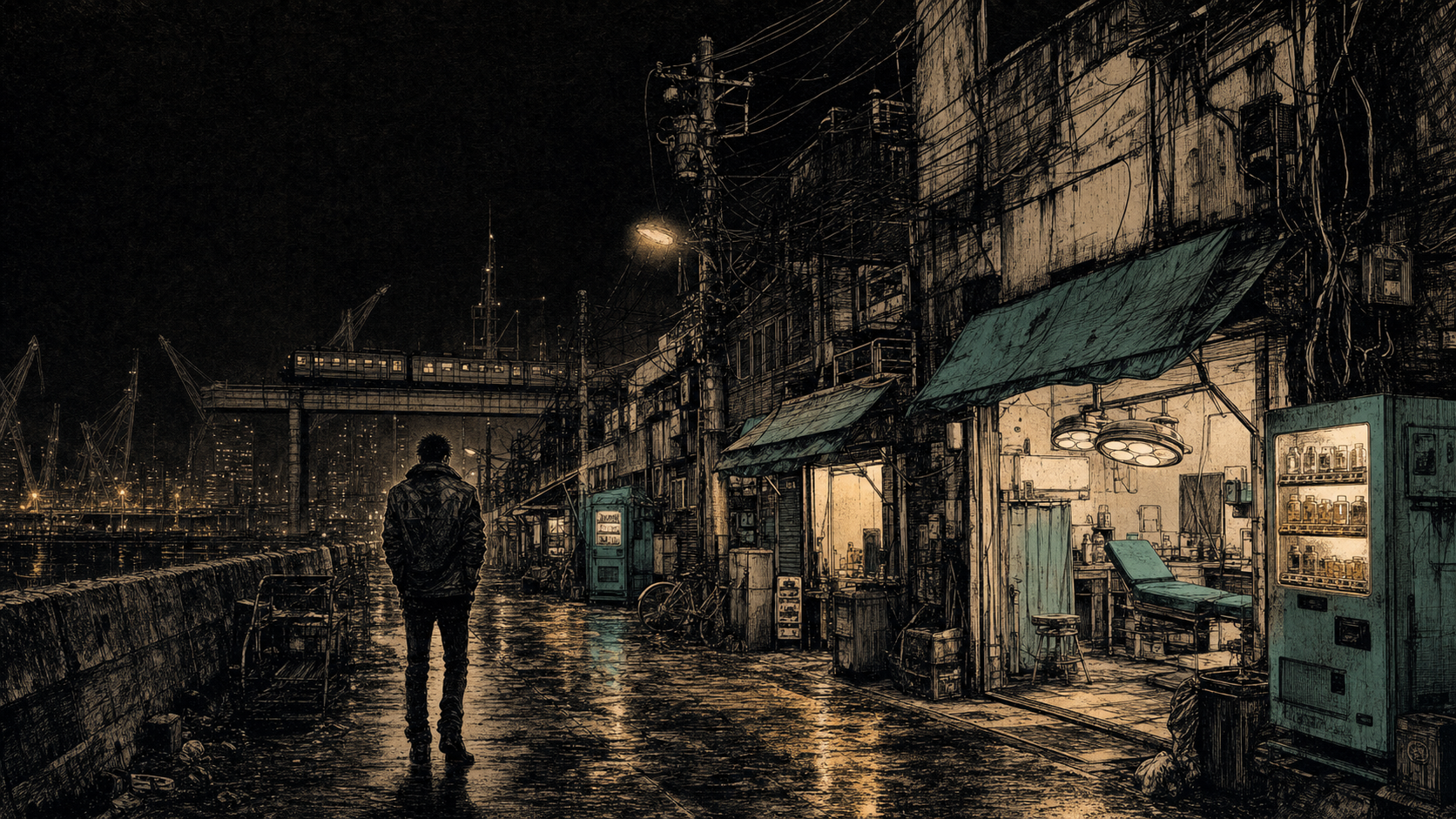

On January 22, 2027, Apple TV will release the first two episodes of Neuromancer, a ten-episode adaptation of William Gibson's novel. The remaining episodes will be released once a week until March 19. Case is played by Callum Turner, Molly by Briana Middleton, and Armitage by Mark Strong. On paper, everything looks almost indecently well: a generous budget, serious actors and a format in which there is no need to cram three continents, two realities and several types of madness into two hours of screen time.
For the novel, published in 1984, this is the first full-fledged film adaptation. For forty-two years, Hollywood approached the book, announced the next director, showed sketches and retreated again. During this time, the future from “Neuromancer” managed to become someone else’s movie, computer game, advertising language and, in some places, the order of things.
Not the first cyberpunk, but the first collected
To say that Gibson single-handedly invented cyberpunk would be both convenient and incorrect. Before him, there was already the techno-noir of Philip K. Dick, the urban paranoia of John Brunner, the cold landscapes of James Ballard, comics Métal Hurlant and Ridley Scott's Blade Runner. The word itself cyberpunk appeared in a short story by Bruce Bethke that predates Neuromancer.
But it was Gibson who put the disparate parts into a system. The hacker became the hero of noir. The computer network has become a space where one can enter with body and mind. Corporations have outgrown states. Artificial intelligence has ceased to be an iron butler or an electronic monster and has acquired its own plan. Advanced technology turned out to be not a promise of general prosperity, but an expensive tool in a world of cheap human life.
Neuromancer was not the first work of the genre. It became the book after which the genre understood what it sounds like, what it smells like, and who it sends to do the dirty work.
Gibson's debut novel won a Hugo Award, a Nebula Award, and a Philip K. Dick Award. For science fiction, this is almost a complete ceremonial set. But the dictionary turned out to be more important than the awards. Gibson coined the word "cyberspace" in his story "The Burning of Chrome," and Neuromancer made it part of the popular imagination. People have not yet used the World Wide Web, but they have already received the image of a shining matrix, where data looks like cities, and hacking looks like a bank robbery committed by the nervous system.
Why the novel does not age
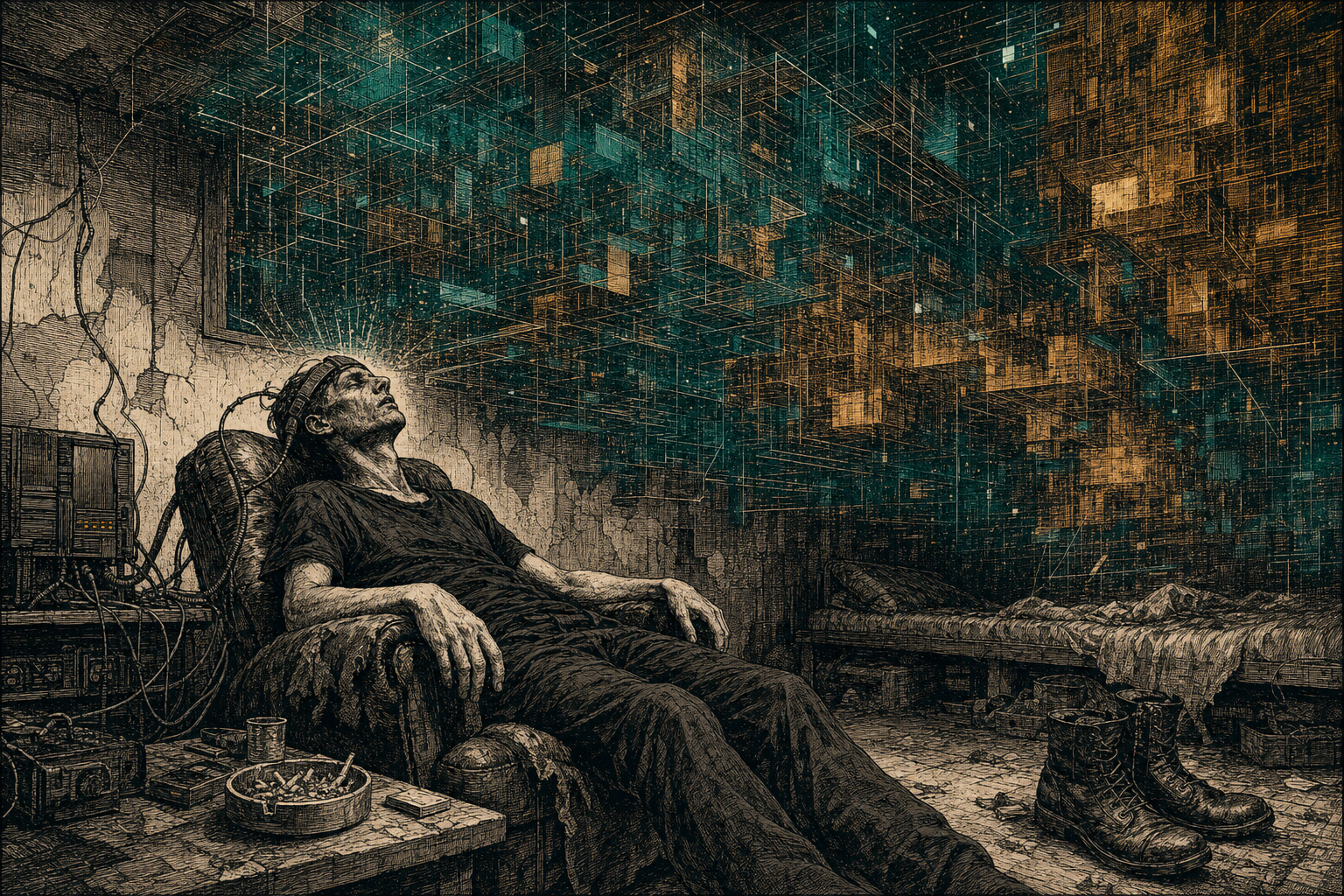
Gibson has plenty of blunders when it comes to household appliances. In his future there is no smartphone that simultaneously replaces a wallet, card and boss, and at the same time regularly reports on the owner. When he wrote the novel, he was barely familiar with personal computers. Therefore, Neuromancer is useful to read not as a list of devices that have come true.
The job is given temporarily, the personality is collected from skills and debts, the body is repaired at a tariff, information costs more than a person, and a private company knows more about the city than its authorities. The rich buy themselves extra time, the poor buy an extra shift. Artificial intelligence does not declare war on humanity. He hires people, hides the purpose of the task from them, and seeks permission to lift the restrictions. This is much more believable than an army of shiny robots.
Every decade recognizes its own future in the novel. In the nineties, we read about hackers and virtual reality. In the 2000s - about global networks. Tenths are about corporations that have become infrastructure. The twenties saw particularly clear signs of artificial intelligence, platform dependency, and a market in which human attention is sold before people even know where they are looking.
Therefore, the book looks old only in the decorations. It's full of wires, terminals, street machines and the Japanese names that the eighties used to signify coming economic dominance. But underneath the plastic lies a familiar pattern: access belongs to the company, risk belongs to the performer, profit belongs to the owner of the system.
The future changes the interface. The agreement remains the same.
Forty years of failed cinema
The film adaptation was taken on several times. At the turn of the century, the film was being developed by Chris Cunningham, the director of Aphex Twin and Björk videos, a man for whom the mechanical body did not need to be explained in words. Gibson called it his personal choice. The project did not take place.
At the end of the 2000s, Joseph Kahn began writing the book. In 2010, the director's chair passed to Vincenzo Natali, the author of "Cube" and "Chimera". He developed the film for years, talked about filming in Canada, Istanbul, Tokyo and London, but this version remained in the file. In 2017, Tim Miller, who directed Deadpool, was appointed director. The matter again did not progress beyond the announcement.
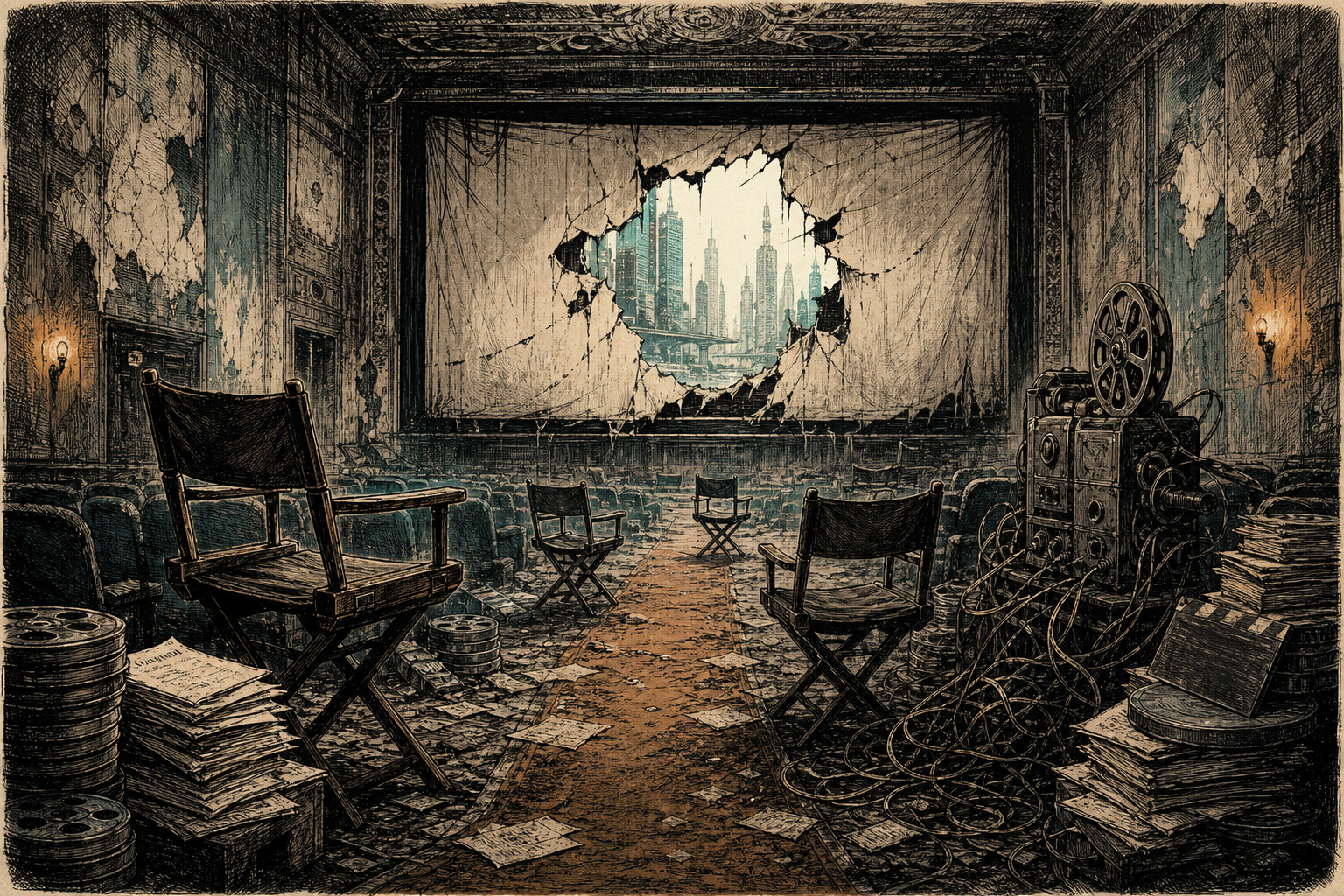
The problem wasn't just rights, money, and the usual Hollywood ability to negotiate getting started for years. Neuromancer really doesn't fit well into a feature film.
Firstly, its main special effect occurs in the head. Case doesn't just look at computer graphics: he experiences the network as space, speed, a drug, and a lost part of his own body. Showing it literally means risking a long cutscene. Explain in words - make the heroes read the user manual.
Secondly, the novel is extremely dense. Case's journey begins in Chiba, passes through Istanbul and ends in orbital Freeside. On the way, a team gathers around him, in which almost no one knows the true purpose of the task. Above the people are the Tessier-Ashpool family and two artificial intelligences; Case guesses the meaning of the robbery later than the reader. If you save everything, the film will suffocate. To simplify, the sense of a world that existed before the first page and will continue to rot after the last will disappear.
Third, the book has already been adapted without permission, and with great care. “Ghost in the Shell,” “The Matrix,” “Johnny Mnemonic,” and dozens of anime series, games and adverts have mined its visual language for parts. The viewer has already seen a console cowboy, mirror lenses, megacorporations, a virtual city and a mercenary with an improved body. A faithful film adaptation today would easily seem like a collection of familiar images, although they became familiar largely thanks to the original.
Apple chose the only reasonable format: the series. In ten episodes, you can maintain the density of the book, and the viewer will have time to stop asking who these people are and begin to fear the answer.
Why Apple has a chance
Apple TV has already learned how to handle expensive science fiction. “Separation” turned an office procedure into metaphysical horror. The “shelter” kept the big world behind a concrete wall. “Foundation” proved, first of all, the presence of a budget, which is also sometimes useful. But for Neuromancer, Killerbot Diaries is more important.
“Killerbot” by Martha Wells is based not on the device of space, but on the inner voice of a security android who hacked his own control module and chose to watch TV series instead of rebelling. His awkwardness, irritation and reluctance to get close to people could easily be turned into a cute fighting robot with a set of jokes. The film adaptation preserved a more difficult thing: consciousness, which is simultaneously inside the body, observes it from the outside and does not want to explain itself to people.
The case is structured differently, but the task is similar. He can't be reduced to the slick guy behind the keyboard. After damage to his nervous system, he perceives ordinary life as an exile. Returning to the matrix is not a working tool for him, but a promise to become himself again - dangerous precisely because it sounds convincing.
Apple has the money for Freeside, ten hours of screen time and strong actors. I have experience in literary fiction. But all this so far only proves the possibility of building a beautiful future.
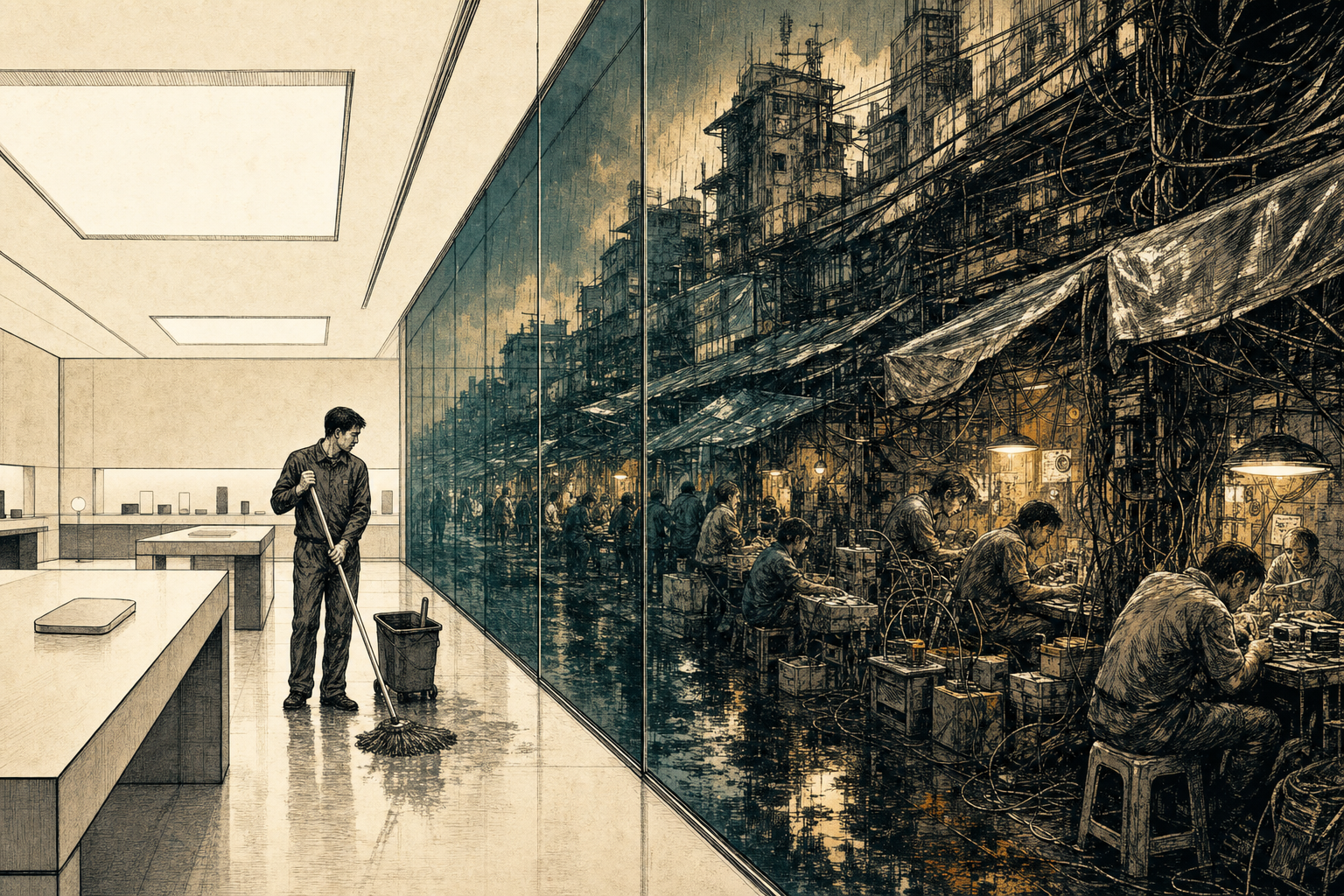
The main risk is making it too beautiful. Gibson's world is dirty, cramped and assembled from incompatible parts. It juxtaposes new technology with cheap plastic, sweaty clothes, addiction, and jobs that are paid for because they can kill. If Chiba turns into an impeccable pavilion, and the matrix into a presentation of a new device, Apple will film the most expensive commercial about the harm of corporations.
Where did cyberpunk go?
Over the past ten years, cyberpunk has simultaneously experienced a second youth and finally disappeared. It disappeared not as a set of images - neon, implants and rain sell well - but as a separate warning about the distant future. Too much has moved into the news.
Novel by Neal Stephenson Reamde came out back in 2011 and marked an important turn. This is not a classic cyberpunk, but a techno-thriller about a ransomware virus, an online game, international crime and people for whom the digital world has long been inseparable from the ordinary one. With Stevenson, there is no need to enter the matrix: a bank transfer, a game item and a kidnapping already belong to the same system. The genre begins to dissolve in modernity.
Blade Runner 2049 showed in 2017 that the old cyberpunk could come back as a big sad movie - without the fuss, but with the memory that someone else's body always belongs to someone. “Altered Carbon” in 2018 turned consciousness transfer into a detective story about class stratification: immortality exists, but its best varieties again go to the rich.
Released in 2020 Cyberpunk 2077. At first, the game itself became a parable about a corporation that sold a beautiful promise before it finished the product. Then the developers corrected it for years. By the end of 2025, sales exceeded 35 million copies, addition Phantom Liberty - 10 million. Anime Cyberpunk: Edgerunners returned to this world what the game’s advertising campaign was missing: a short human life, which the city grinds down, working strictly according to instructions.
Less loud but important works appeared nearby. Animated series Pantheon made the loaded mind a corporate property. French cartoon Mars Express brought back the working class to cyberpunk: robots, investigators and engineers there do not decorate the scenery, but are hired, receive orders and are afraid of losing their place. The series "Peripherals" reached the late Gibson, where power controls the past as a remote branch.
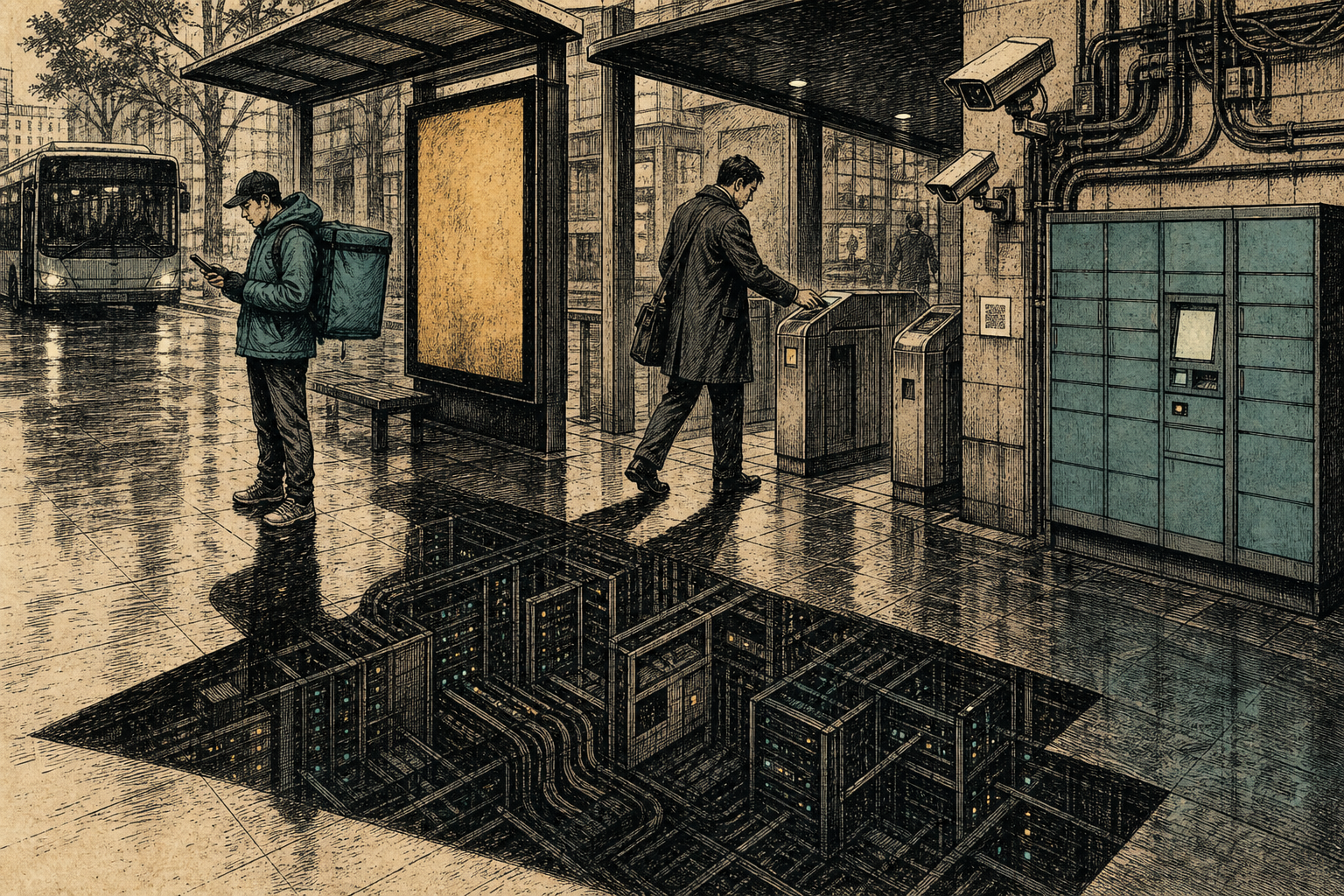
Cyberpunk won so convincingly that it stopped looking like science fiction. His aesthetic became a commodity, his anxiety a user agreement.
Exam for the present
The Apple series is not obliged to accurately restore 1984 and give the viewer a museum copy of the future. Such loyalty would be most useless. The series must preserve the structure of the world: technological splendour at the top, disposable people at the bottom, and heroes who are not going to save humanity because they need to survive the order first.
Any good graphics department can show cyberspace in 2027. It is much more difficult to show why Case is eager to go there, why Molly sells danger as a service and why artificial intelligence understands the structure of the deal better than the people it hires.
If it works, Neuromancer will be modern again.
If not, Gibson's future will still outlive the series. It has already survived several generations of computers, forty years of failed cinema, and its own transformation into the interior of a shopping center.
- Apple TV: premiere date, format and composition of the series
- Apple TV: Killerbot Diaries
- Penguin Random House: Neuromancer edition and awards
- Wired: William Gibson on Vincenzo Natali's version
- Digital Trends: Natalie on the failed film adaptation
- Time: Gibson on technology and reading a novel today
- CD Projekt: Cyberpunk 2077 sales
- CD Projekt: Phantom Liberty sales