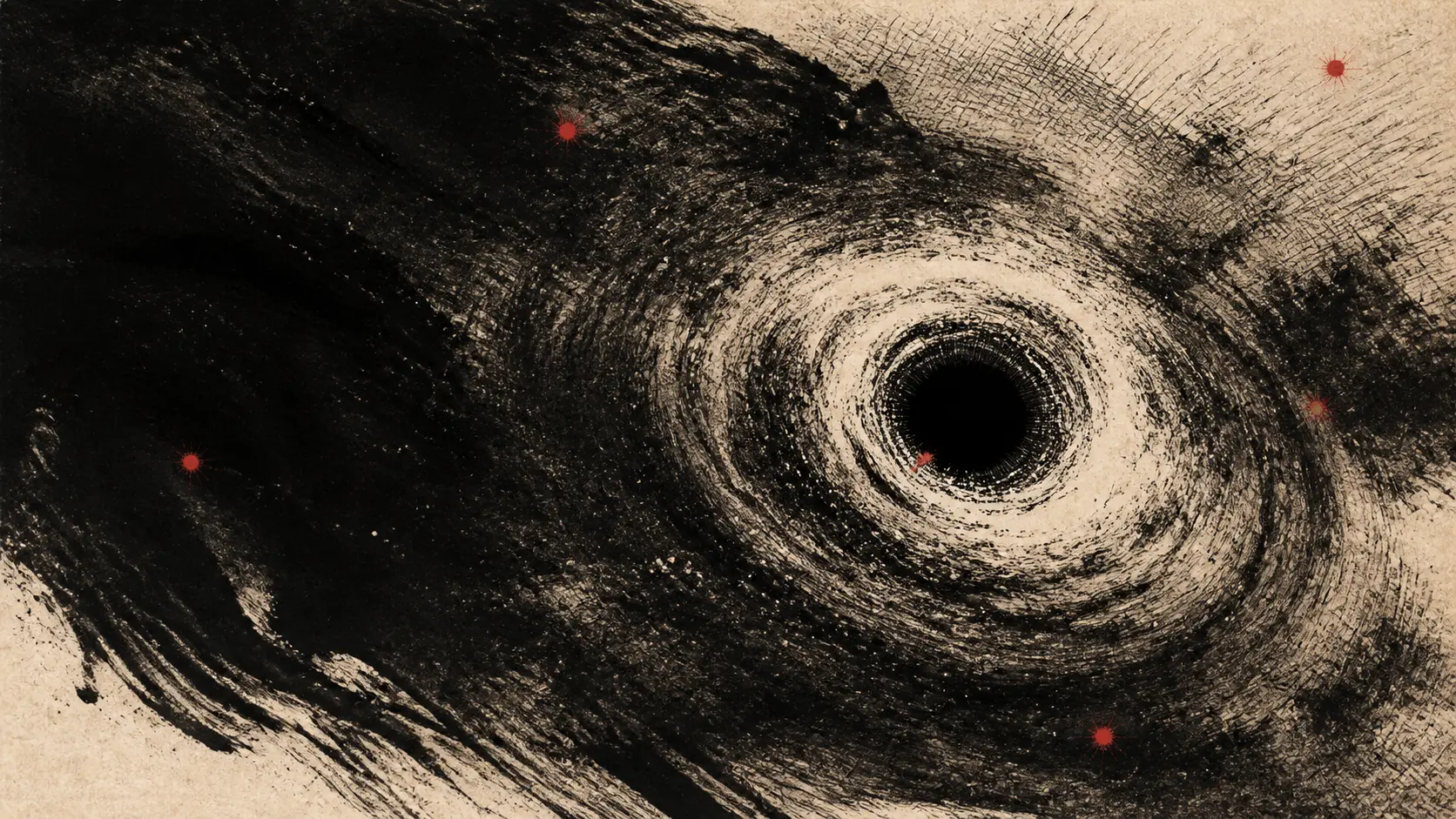

Compact red sources appeared shortly after the Big Bang and almost disappeared a billion years later. Data from 2026 links some of them to supermassive black holes in dense cocoons of gas. The answer for the entire class has not yet been found.
Six dots on a black background
The NASA mosaic features six objects. Each one has a white-yellow center and a reddish halo. The service names next to them are: CEERS 14448, NGDEEP 4321, PRIMER-COS 10539, CEERS 20320, JADES 9186 and PRIMER-UDS 17818. Redshift - from 4.75 to 8.92. The most distant of these six is visible as it was when the Universe was not even 600 million years old.
The images are compiled from multiple exposures of the NIRCam infrared camera. The photographs taken through different filters were in black and white; red, green and blue were assigned to them during processing. This mosaic shows the range of the F444W filter in red, F200W in green, and F115W in blue. Therefore, Little Red Dots, “little red dots,” is the name of an observation class, and not a description of what the human eye would see nearby.
Redness is still physically important. The expansion of the Universe has stretched light and moved it into the infrared region. The color is also influenced by the source itself: stars, dust, hot gas around the black hole. The word turned out to be simple, the object was not.
The first points were found in Webb data in 2022. Astronomers then compiled them into different surveys of the early universe. Almost all known LRDs date back to the first one and a half billion years after the Big Bang. NASA indicates that the population becomes noticeable around the 600 million year mark and declines sharply after less than a billion years. In the nearby Universe, it has no reliable analogues yet.
It’s not the galaxy that may be shining at the point
At first, some of the LRDs were mistaken for very dense young galaxies. If red light is attributed entirely to stars, the result is large stellar masses in a small volume. From here grew stories about impossible galaxies that matured too early.
The spectra spoiled this clear picture. A broad Hα line, hydrogen emission, was detected at many points. Width means the gas is moving at a high speed. Such gas is usually located next to a black hole: it falls towards it, heats up and releases energy in front of the event horizon.
The black hole itself does not shine. Energy is released by a substance that falls towards it and heats up. If this radiation is taken to be the sum of stellar light, the mass of the galaxy will be overestimated. The object will appear older and heavier than it is. Therefore, early reports of “impossible galaxies” did not bring down cosmology. They showed that photometry is not enough: first you need to separate the contribution of stars and the active nucleus.
In a study based on data from the EIGER and FRESCO surveys, broad Hα components were found in compact sources at redshifts from about 4 to 6. The authors associated them with active galactic nuclei. The red central source there is juxtaposed with bluer star-forming regions. In this picture, a black hole grows inside a young galaxy, but at a certain stage begins to contribute a significant portion of its optical light.
This has not been proven for all LRDs. Under one color selection, different objects can be hidden: active nuclei, dense star systems and mixed options. The dot in the image reveals nothing about its biography. This requires a spectrum.
Why don't they look like quasars?
The habitual active core gives itself away in several ways. Fast matter produces broad spectral lines. The region near the black hole emits X-rays. Dust further from the center heats up and shines in the infrared. For small red dots, this set is often not fully assembled.
There are broad lines, but no X-ray emission has been detected from most objects. The characteristic hot dusty “torus” familiar from nearby active galaxies is also not always visible. In 2024, the lack of an X-ray signal and noticeable variability was even used as an argument against a simple explanation of LRDs by ordinary active nuclei.
In April 2026, NASA reported the “X-ray spot” 3DHST-AEGIS-12014. It may be a transition object between small red dots and the usual growing supermassive black holes. One X-ray finding did not solve the problem. She added a possible in-between shot.
Models must explain the whole set at once: compactness, red spectrum, broad hydrogen lines, weak X-rays and the absence of the usual dust pattern. The simple word “quasar” is not enough for this.
Thirty hours for GLIMPSE-17775
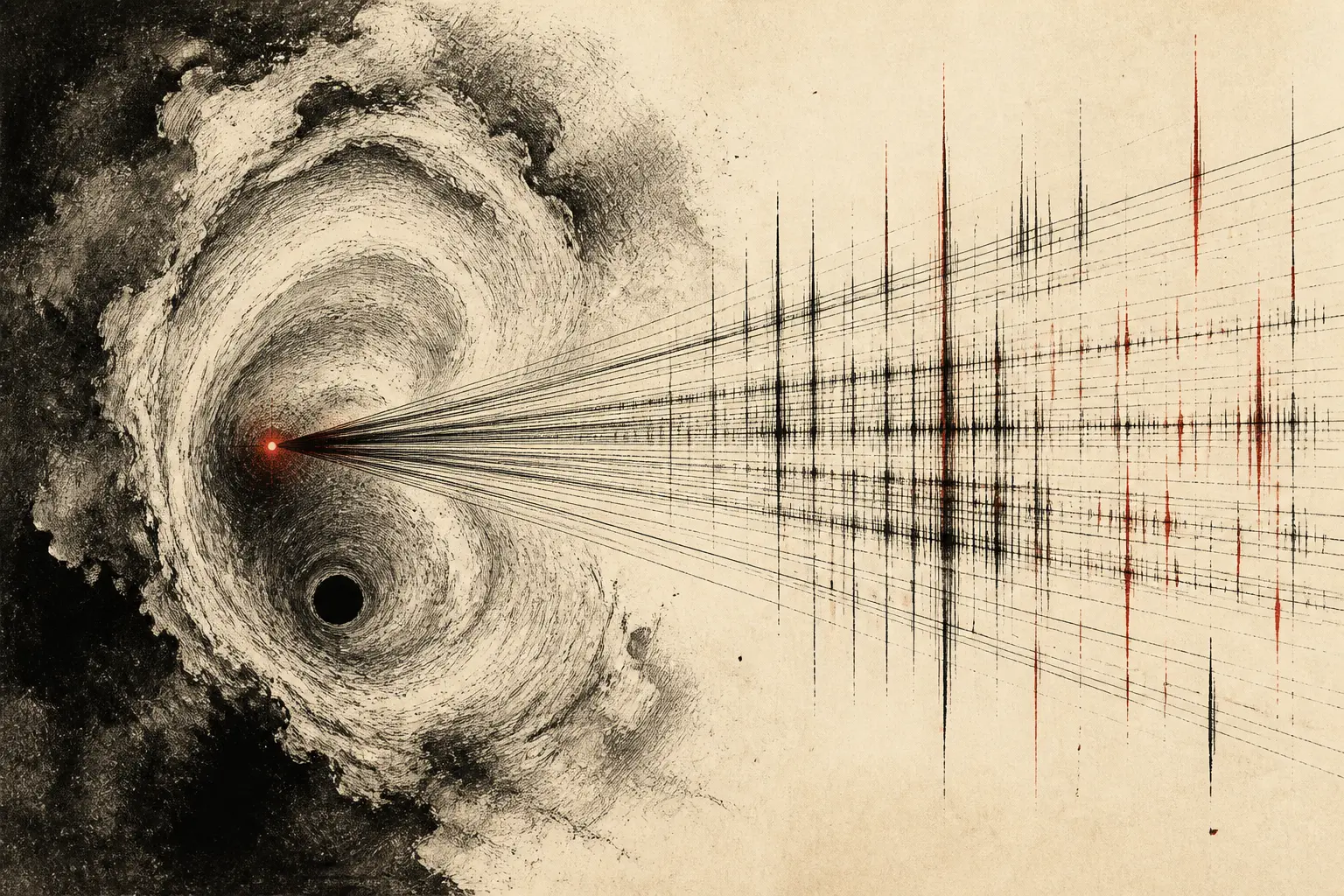
The best LRD spectrum to date was obtained for the object GLIMPSE-17775. It found itself in the observation field of the galaxy cluster Abell S1063. The cluster acted like a gravitational lens: its mass curved space and amplified the light of a distant source. Webb observed the field for about 30 hours.
More than 40 lines were distinguished in the spectrum of GLIMPSE-17775. They showed four elements: hydrogen, helium, oxygen and sulfur. Other independent features coincided with the BH* model, or black hole star.
The name is easy to misunderstand. This is not a star with a black hole instead of a core. At the center of the model is a supermassive black hole. It is surrounded by a dense cocoon of partially ionized gas. The light is scattered and processed inside the cocoon; a red spectrum emerges, unlike the radiation of an ordinary quasar. Dense gas can also hide the X-ray signal.
On June 10, 2026, NASA named GLIMPSE-17775 as the strongest evidence in favor of such a scenario. The head of the work, Vasily Kokorev, noted that previously individual parts of the picture were found in different LRDs, but here they are gathered in one spectrum. The wording refers to one object. The remaining points still need to be checked with a comparable depth.
A hole weighing 50 million suns
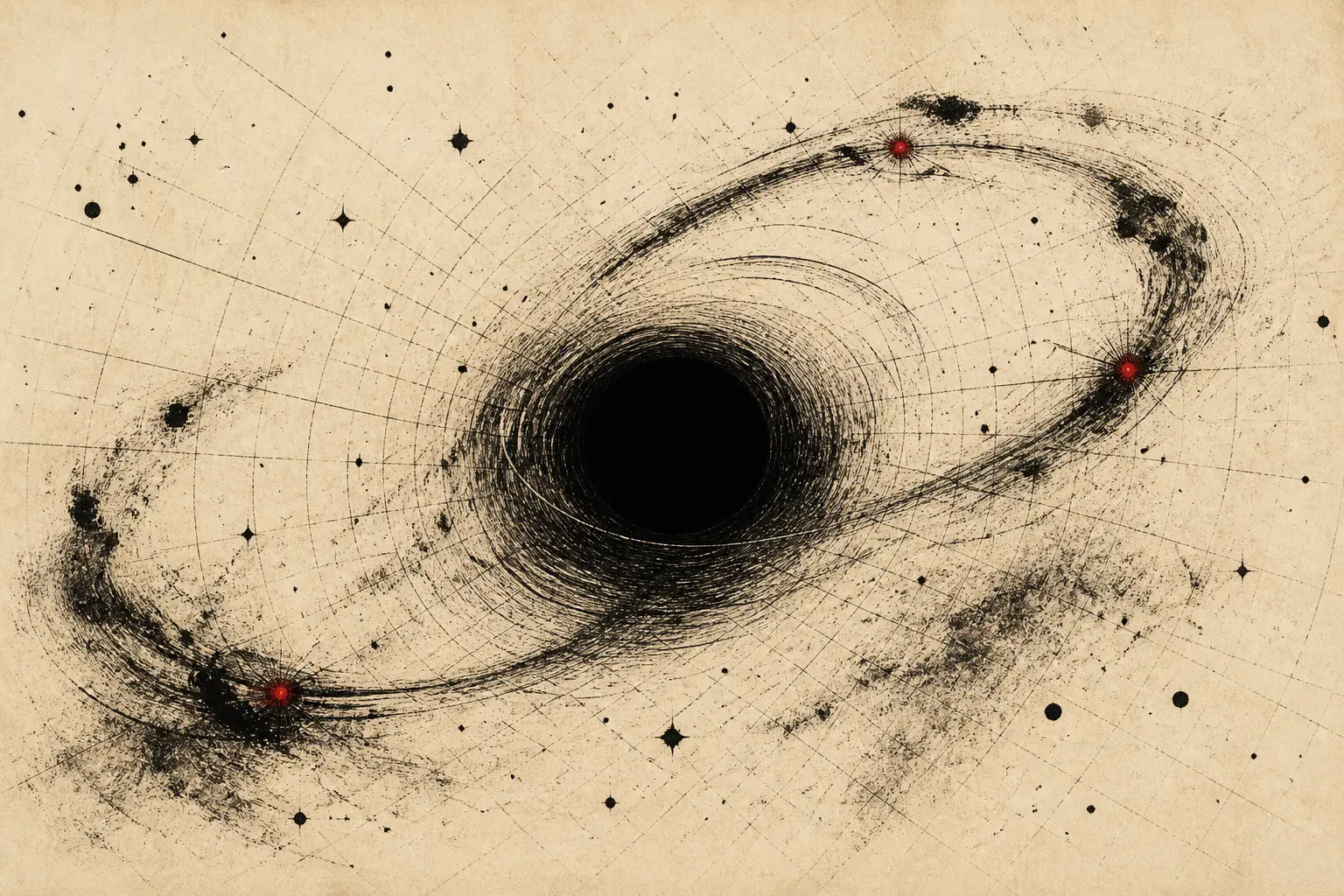
Another object, Abell2744-QSO1, existed approximately 700 million years after the Big Bang. Its image was enhanced by the Abell 2744 cluster, known as the Pandora cluster. The lens produced three images of the same little red dot.
In 2026, researchers tracked the movement of gas around the center of QSO1 and calculated the mass from its velocity. The result was about 50 million solar masses. The team estimates that the black hole makes up at least two-thirds of the object's total mass. Such a balance is not typical for nearby galaxies: there the central hole usually occupies a small fraction of the total mass.
The gas in QSO1 consists almost entirely of hydrogen and helium. The content of elements heavier than helium is less than 0.5 percent of the sun. Many generations of stars have not yet had time to live there and scatter oxygen, carbon and iron throughout the environment. However, the supermassive black hole was already in place.
This changes the order of the usual story. Usually, a galaxy appears first, massive stars are born and die in it, their black holes merge and grow. For QSO1, the researchers suggest another path: a large gas cloud could immediately collapse into a heavy “seed,” bypassing the long buildup from the stellar remnant.
Direct collapse has long existed in theory. QSO1 provided a rare opportunity to test it by measurement rather than by brightness alone. But here we are talking about one well-magnified object. It is impossible to transfer its origin to the entire red population.
Where did the dots go?
Little red dots are numerous for a short period of cosmic history and then almost disappear from samples. So LRD may be a stage rather than a permanent object type.
The dense gas first feeds the black hole and at the same time hides it. As it grows, radiation and flows of matter clear the environment. The red cocoon becomes more transparent; the bluer active center comes out. In this scenario, the LRD turns into a quasar or a young galaxy with a noticeable nucleus. Verifying this sequence is difficult: astronomers see different objects at different moments, rather than seeing one object over hundreds of millions of years.
There are also other options. Some of the red dots may turn out to be dense star systems. In part, both stars and accretion provide light. Selection criteria also vary between reviews. Even the term LRD still groups sources based on external features rather than a proven mechanism.
The next step is more boring than the headline about broken physics: obtain deep spectra, look for X-rays, measure variability, chemical composition and gas movement. GLIMPSE-17775 required about 30 hours of observations plus a lucky gravitational lens. Without such luck, many dots will remain a few red pixels.
The latest data brings some researchers closer together around the model of a black hole in a gas cocoon. But the strongest evidence comes from GLIMPSE-17775, and the direct mass measurement is from QSO1. Between two successful objects and an entire class there are still hundreds of points without such detailed spectra.