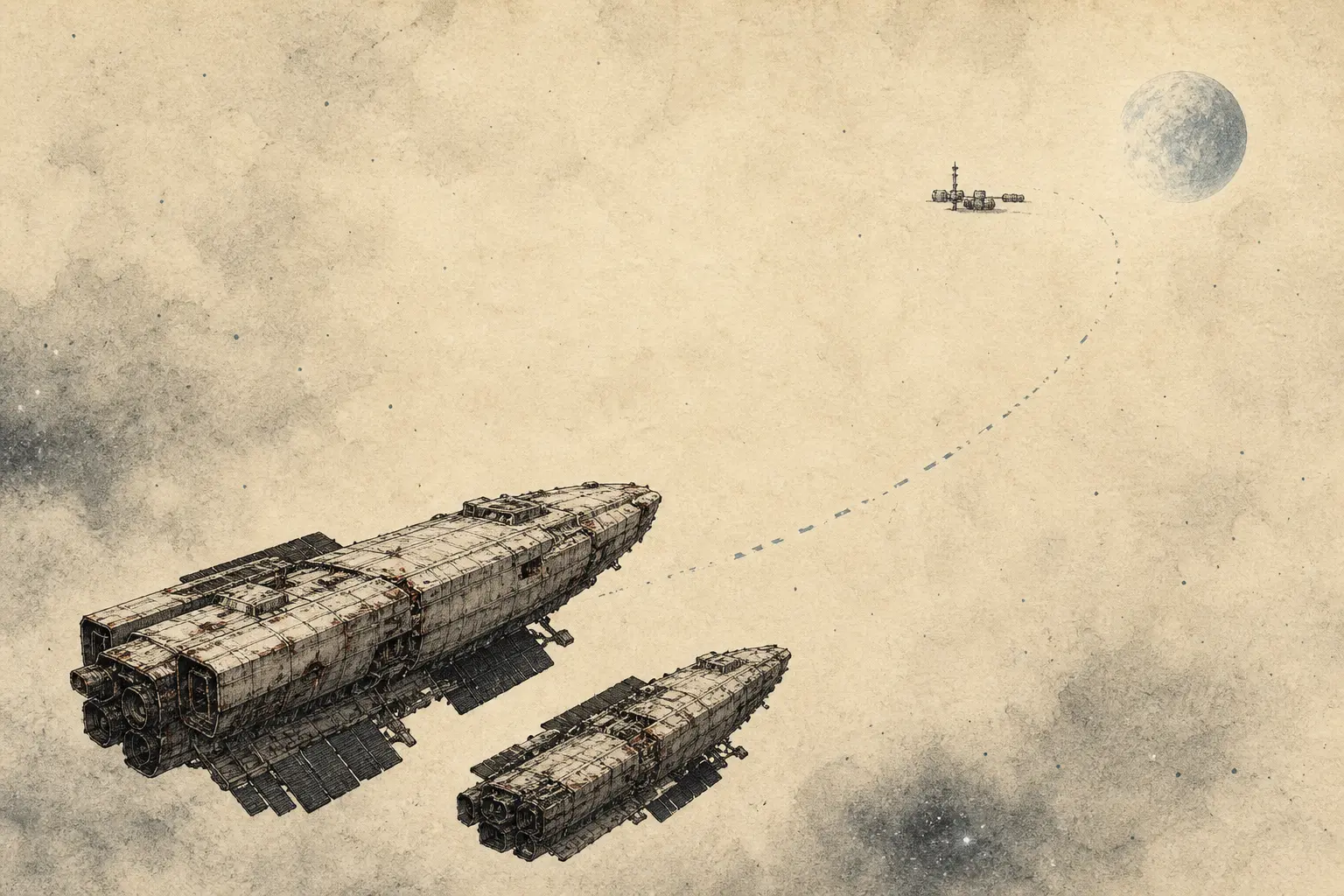

A ship with nowhere to return
Terra Invicta is a global computer strategy about humanity's fight against an alien invasion. First, the player leads a political organization, fights for influence on Earth and masters the solar system. Then it comes to warships. They are assembled from individual components: the body, engine, reactor, missiles, armor and radiators are selected. Here the first warship is easy to build incorrectly.
Everything looks convincing in the designer. Then the ship leaves the station, gets to the enemy - and it turns out that it can no longer return. The fuel did not run out in the usual sense. The ability to noticeably change speed has ended.
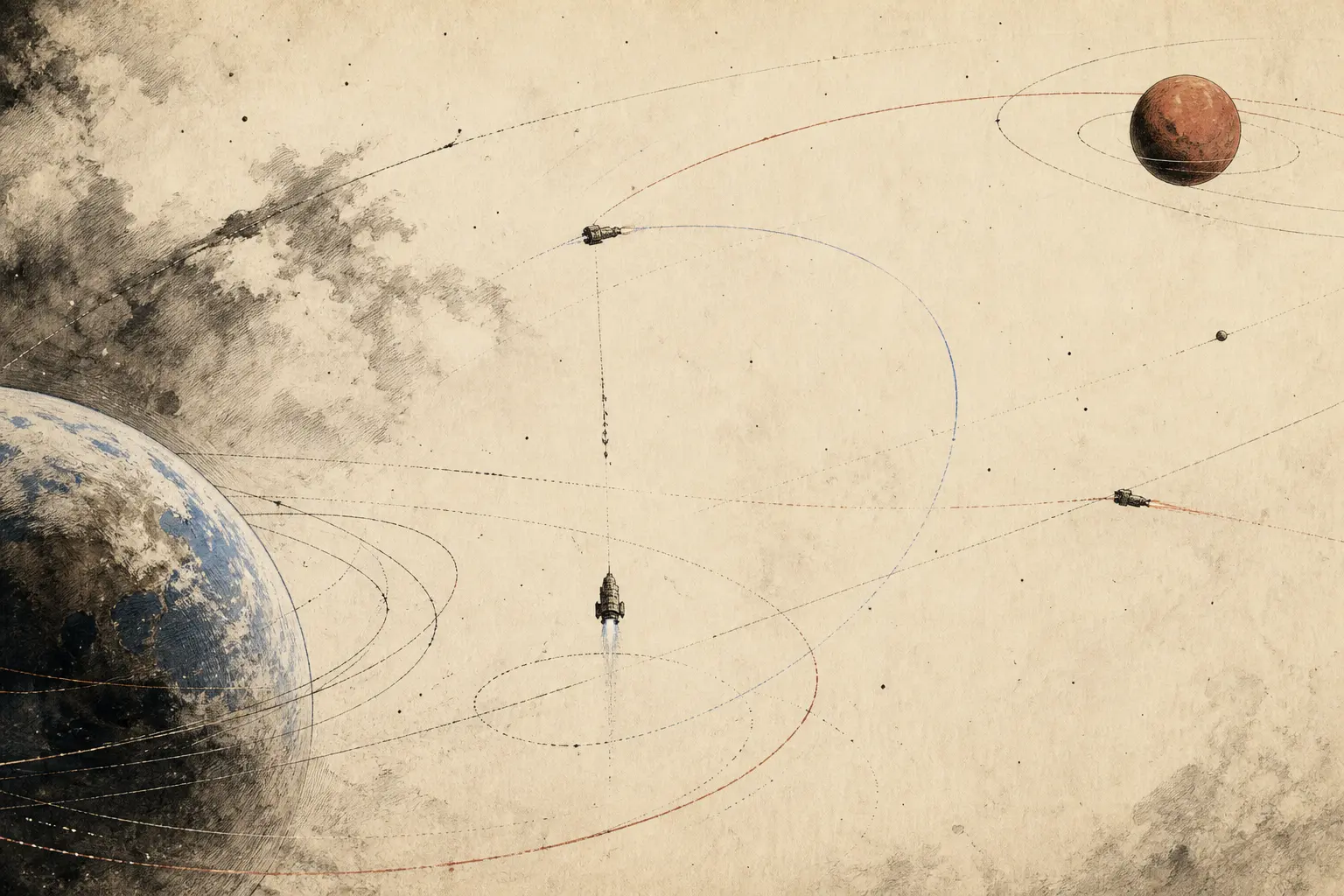
In astronautics, this reserve is called delta-v. It shows how many speed changes the device can accumulate over the entire flight. The reserve is spent on transition between orbits, interception, braking and evasion. If it is used up in battle, a serviceable ship will remain where victory found it.
On the game forum, the question about delta-v was once formulated without diplomacy: explain already what it is, or just give a ready-made ship design. In response, experienced players began to count the way to the goal and return to the repair station. A warship with good weapons, a large reserve of speed and weak thrust also turned out to be a bad deal: there is a lot of fuel, but there is not enough thrust to quickly spend it. In battle, such a device slowly floats towards missiles.
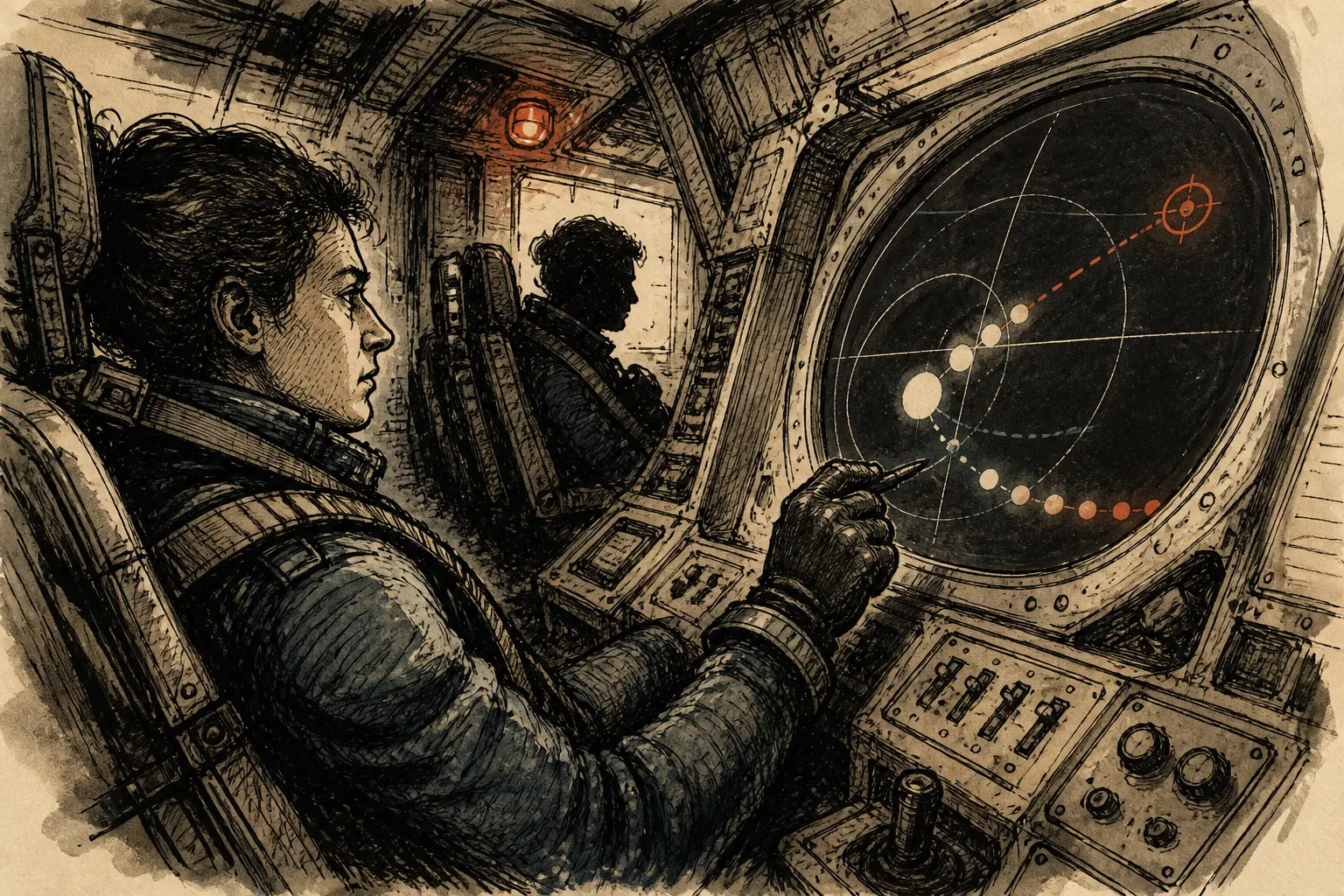
"The Expanse" is a science fiction series based on the novels by James Corey. Its action takes place in the developed solar system, divided between the Earth, Mars and the inhabitants of the asteroid belt. The series shows the same calculations not in tables, but through people’s bodies: before acceleration, the crew lies down in their seats, takes anti-overload medications and waits to see if the vessels will withstand the next maneuver.
The game and the series are more useful than the usual conversation about lasers and railguns. Space combat begins in the design office, where they decide what proportion of mass to allocate to fuel, cooling, armor, sensors and people. Any decision makes the ship better in one place and worse in another. In the emptiness there is no place to park and top up what is missing.
There is already a war, there are no cruisers yet
Warships between Earth and Mars remain a fantasy. Military confrontation in space - no. Satellites provide communications, navigation, missile warning and Earth observation. To deprive the enemy of these capabilities, it is not necessary to launch a cannon into orbit. You can attack the control channel, jam the signal, blind the sensor, interfere with the operation of the ground station, or damage the device itself.
The US Space Force divides such warfare into three areas: orbital, electromagnetic and cyber. This is the doctrine of one country, not a neutral description of the future, but the list of vulnerabilities is indicative. The space system consists of a vehicle, a communication link and a ground segment. You can hit any of them. A satellite that has lost control may remain intact and at the same time cease to be useful.
Therefore, the first real space battle will most likely not be seen from the window. Telemetry will disappear on the operator’s screen. The device will not carry out the command or will begin to unexpectedly change its orbit. The reason will be unclear: a breakdown, interference, someone else's program or an approaching satellite. While experts are figuring out what happened, everyone else is already looking at the information that came a few seconds ago.
Space is not like the sky
An aircraft changes direction by pushing against the air. A ship in a vacuum has no such help. Its nose need not point in the direction of travel: it can turn its engines forwards and brake while continuing along the same trajectory, or rotate sideways without changing course. Films have long staged space combat as a dogfight without air. Physics took no offence and remained unchanged.
To turn not the hull, but the trajectory, the ship must create thrust. For a small change, a shunting engine is enough. For a sharp one, you will need a large impulse, and with it fuel. The rocket equation makes the problem unpleasant: the extra fuel itself has mass. The more you take it, the more you have to accelerate, and each new ton gives an ever smaller increase in the speed reserve.
Terra Invicta separates two characteristics that conventional fiction often merges. Delta-v determines how much a ship can change its velocity over a journey; thrust determines how quickly it can do so. An efficient interplanetary craft may take months to build speed and prove almost useless in close combat. Fit a powerful engine and the ship can leave the line of fire quickly, but a handful of manoeuvres may empty its tanks.
The series "Space" translates the same calculation into human language. Before the turn flip and burn the crew lies down in their seats and takes medications to help them survive the overload. The ship turns 180 degrees, turns on the engine and brakes with thrust. In the frame it looks spectacular, but the spectacle is paid for with the bodies of people. The body withstands acceleration better than the blood vessels, spine and heart.
The series makes one magical concession: the Epstein drive. It provides sustained thrust while consuming a fantastically modest amount of reaction mass, bringing the Solar System within narrative reach. Without it, flights, pursuits and political crises would unfold far more slowly. Yet once the engine starts, the characters must endure the consequences under their world's own rules. Physics works here not as a footnote but as a reliable source of human discomfort.
The enemy is always in the past
Light takes time. Across three million kilometres, a signal travels for ten seconds. An observer sees not the enemy's present position but where it was ten seconds ago; a response takes another ten seconds to arrive. With millions of kilometres between ships, manual weapons control from Earth becomes a correspondence with the past.
The delay itself does not prohibit shooting. Automation calculates the target's movement and directs the weapon to where it should end up. The difficulty is different: during the missile’s flight, the enemy can change course. The earlier this maneuver is noticed and the more accurately the engine's capabilities are known, the smaller the area of uncertainty. First you need to detect a point, then measure its movement and only after that predict the meeting.
In the episode CQB "Space" unidentified ships primarily jam the communications of the Martian battleship "Donnager". Then there are missiles, close-in defenses, and railguns. Consistency is more important than a set of weapons. An isolated ship is deprived of external sensors and assistance, and only then receives a hole.
The modern war for satellites is structured in a similar way, if only because data must be transmitted. The orbiter does not exist separately from the antennas, programs, control centers and users on Earth. A broken communication line can do what a movie requires a beautiful explosion to achieve.
The radiator has to be hidden from bullets
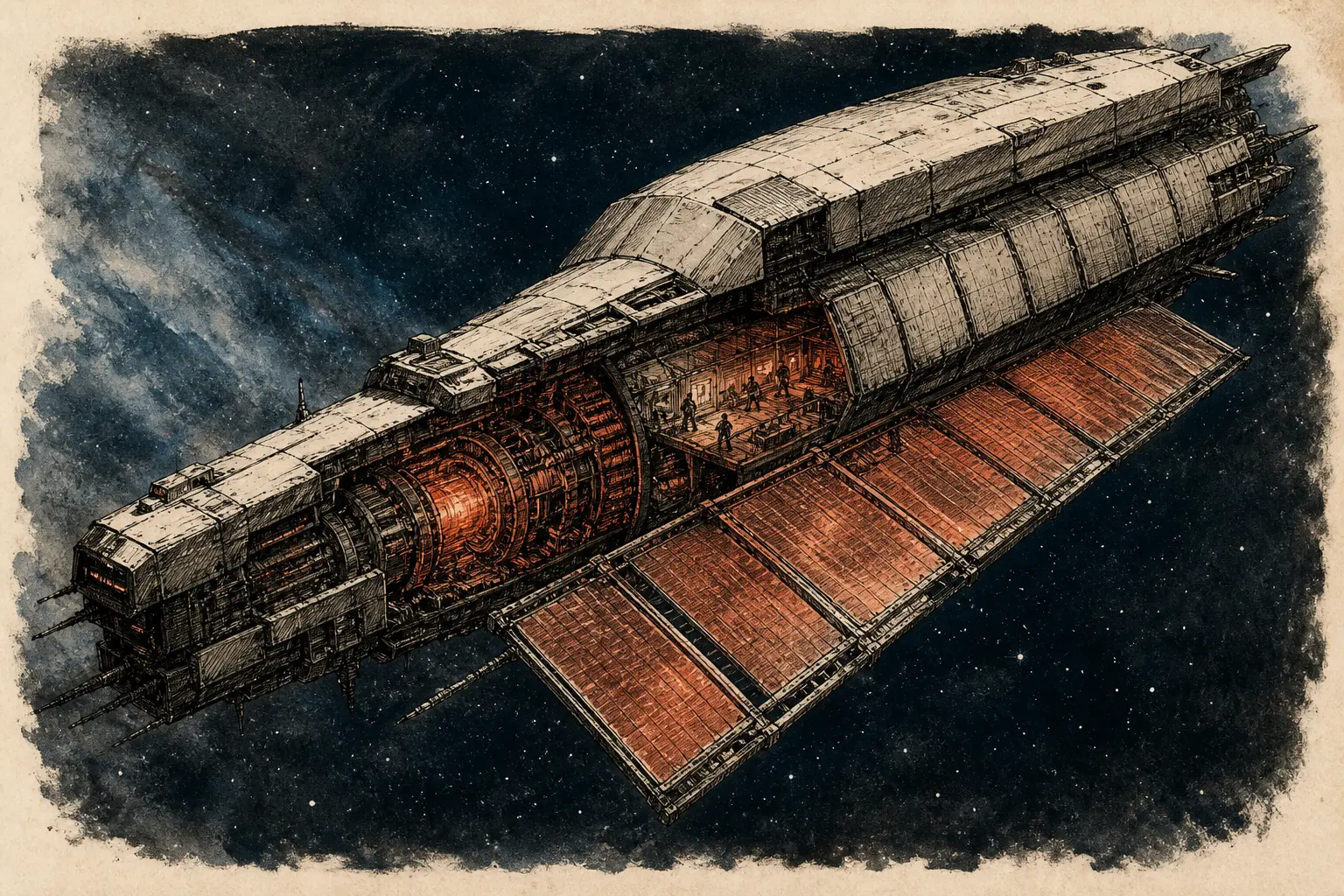
Vacuum almost does not remove heat by conduction and convection. The ship gets rid of it with radiation. To do this, we need radiators - surfaces through which the energy of the reactor, electronics, life support systems and weapons escapes outward. The more power a device consumes, the more serious its thermal management becomes.
B Terra Invicta the radiator can be removed behind the armor before battle. After this, heat begins to fill the internal storage. The ship shoots and maneuvers for some time without exposing the fragile panels. When the capacity is exhausted, the radiators have to be opened. The game does this automatically: physics does not ask whether it is convenient for the commander to become more visible and expose a vulnerable surface to fire.
So a good combat situation appears without a single new type of weapon. The ship can continue to fight with closed radiators and overheat. May open them and cause damage. It may reduce power, stop firing, or disable some systems. Either option saves something and pays something.
“Space” basically hides this account. The viewer sees huge engines, long accelerations and railguns, but rarely sees surfaces capable of discharging the heat they produce. Fans of the series have been discussing this gap for years. Explanations through the heat capacity of the body or the release of a hot working fluid help individual scenes, but do not solve the issue entirely. Epstein's engine turns out to be a miracle of traction and at the same time a miracle of cooling.
The laser adds another line to this accounting. Its beam travels at the speed of light, but the installation does not convert all the energy consumed into radiation. The remainder heats the equipment and the ship. The beam itself diverges due to diffraction: the farther the target, the larger the spot and the less energy per unit area. Optics size, wavelength, pointing accuracy, and cooling may be more important than a nice power rating.
Invisibility begins with doubt
A hot engine is visible from afar. It seems that the solution is simple: shut down the reactor, remove the radiators and turn into a black lump. This can reduce the thermal signature, but cannot erase the flight history. The enemy had already seen the operation of the engine, measured the direction and made a forecast. A shutdown ship does not disappear; it continues to move along a known trajectory.
The task of camouflage is therefore more modest and more interesting. You don't need to become completely invisible, but increase your search area. Weak pulses of cold gas gradually move the apparatus away from the calculated line. False targets add new marks. The geometry of the Sun and planets interferes with observation. Heat can be accumulated inside for some time, choosing the moment when the enemy is worse positioned for measurements.
But the supply of uncertainty is also finite. Each engine leaves a new sign. The heat storage tank is filling. Onboard systems require energy. A ship with a crew must maintain pressure and temperature for people. Camouflage becomes less of an invisibility cloak and more of a long-running attempt to force the enemy to waste sensors, missiles, and time on a few likely targets.
Good weapons are not enough
In games, a debate about weapons quickly turns into a search for the one winning button. Reddit by Terra Invicta is valuable in the opposite way: players discuss the order of threats. Kinetic projectiles cause enemy lasers to switch to defensive mode. While they crush the flying metal, the ship fires missiles. If the salvo is dense, the close-in defense system does not have time to process all targets.
The missile itself corrects its movement and is therefore dangerous at a long distance. It is capable of withstanding overloads that are unacceptable for the crew. However, a rocket needs an engine, a sensor, fuel, and communication between parts of the system. It can be detected, deceived or destroyed. The ship's ammunition is limited, and each miss remains wasted mass, which was previously launched into space.
The laser does not need to be guided to the target for several hours. Its weak point is beam divergence, pointing accuracy and heat. So a plausible role for a laser could be defensive: damaging a missile's optics or heating a vulnerable element as the target gets closer. Burning through armor at great distances will require large apertures, power and ruthless precision.
A railgun or coilgun uses an electromagnetic field to accelerate a metal projectile. At high speed, a small slug carries enormous kinetic energy, but it cannot correct an error. At long range the enemy has time to move, while the shot itself reveals the power plant at work. In The Expanse, railguns become close-range weapons, terrifying precisely because so little time remains to evade them.
No system solves the battle separately. Missiles force interceptors to be wasted. Kinetic projectiles take up lasers. The maneuver consumes delta-v. Firing fills the heat sink. A damaged sensor reduces the distance at which the ship is able to defend itself. Victory comes at the moment when the enemy is still intact, but can no longer see, cool down and dodge at the same time.
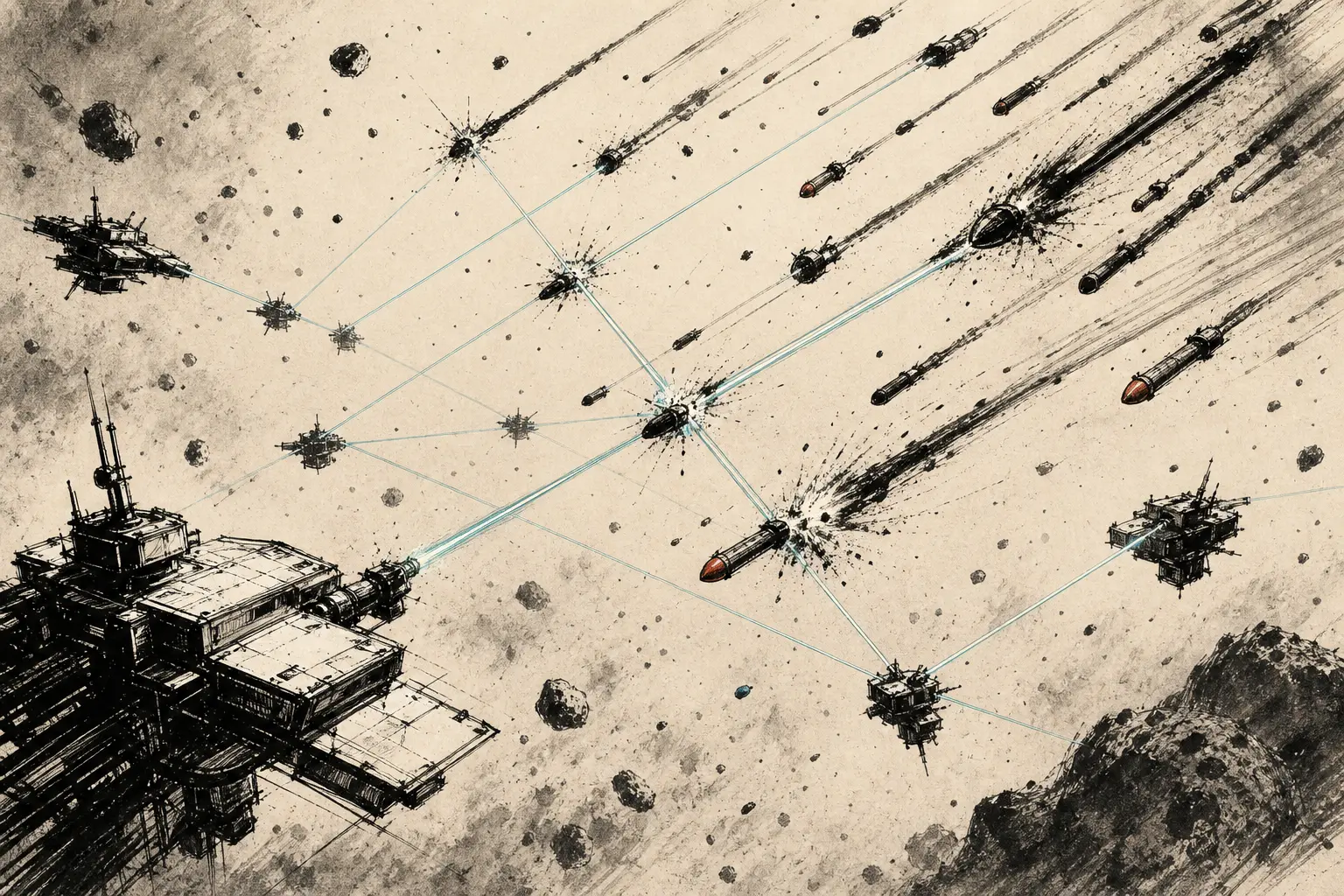
Why won't the ships fly shoulder to shoulder
A dense formation fits beautifully into the frame and does not feel good under fire. A damaged ship creates a cloud of debris. Neighbors block each other's observation sectors, risk being hit by friendly weapons and are forced to take into account the operation of other people's engines.
But this does not mean that the system will disappear. B Terra Invicta ships cover each other with close defense means. Several installations manage to process more missiles than one. This means that the devices will disperse so far as not to die from one defeat, but will retain the ability to combine sensors and fire.
On the screen it hardly resembles a fighter formation. Rather, it is a set of points separated by hundreds or thousands of kilometers and connected by calculation. One ship sees, another shoots, the third saves ammunition for interception. People inside may never see their neighbors with their own eyes.
The battle ends before the hole is broken
Let's imagine two groups of ships between Earth and Mars. The parties know each other's approximate trajectories. Several devices stop transmitting normal telemetry and reduce thermal radiation. Their last known positions remain on the screens, and areas of uncertainty gradually grow around the calculated lines.
Reconnaissance vehicles and external telescopes are trying to clarify targets. One communication channel goes dead. It is unclear whether this was due to interference or a breakdown. The commanders are rebuilding the network: one ship relays data through another, but the signal takes longer. Automation already works with an incomplete picture.
The first salvo is fired not at a point, but along several probable trajectories. The missiles spend hours closing the distance and adjusting course from time to time. The defenders respond with decoys and interceptors of their own. Lasers begin to work when the optics of the missiles become available for confident tracking.
Kinetic projectiles give the defence system more targets. Some mounts turn on the incoming metal while others keep tracking the missiles. A ship suddenly changes velocity and slips away from the calculated intercept point. The manoeuvre saves it from part of the salvo while the hot flare of its engine reveals its new position.
The temperature inside is rising. The radiators are removed, the storage is almost full. You can stop firing and reduce energy consumption, but then the next salvo will go through the weakened defense. You can open your radiators, quickly release heat, and become a comfortable thermal marker. You can maneuver again and spend the rest of the delta-v.
One fragment penetrates the external structure. It doesn't spit out the entire crew into a vacuum or turn the ship into a fireball. The radiator drive is damaged. The temperature continues to rise. After a few minutes, the automation turns off some of the weapons, then reduces the power of the sensors. The hull is still intact, people are alive, the engine is able to work. The battle is already lost.
People are the most demanding system
Man needs air, water, space, acceptable temperature and protection from overload. All this has a lot. An unmanned missile can turn sharper without worrying about blood circulation. The automation will calculate the interception faster and will not be confused after a hole in the adjacent compartment.
Remote control has its limits: signal delay and interference. An operator on Earth will not be able to navigate a ship between planets the way a pilot controls a drone several kilometers away. A significant part of the decisions will have to be made on board. The question is whether there will be a person there.
"The Expanse" leaves the crews because the series needs fear, error, order and responsibility. The authors could fill the sky with autonomous vehicles, but then the battle would become a conversation between machines, which people watch belatedly. Terra Invicta, on the contrary, almost dissolves the crew in the characteristics of the ship. The player monitors the thrust, weapons and heat, rarely remembering who exactly is sitting inside.
The actual choice may be a mixed bag. The vehicles will accompany targets, manage defenses and perform maneuvers. The person will remain where the decision cannot be reduced to ballistics: whether to consider the mark an enemy, whether to continue the attack after losing contact, whether it is possible to open fire on the device near civilian infrastructure. But it is not necessary to be present on the ship itself for this.
After the battle in Terra Invicta the player again unlocks the characteristics of the fleet. The enemy is destroyed, the missiles are spent, the radiators are opened. Our own ships are still able to move. Then the eye falls on the delta-v remainder. It's not enough to get to the repair station.
Victory remains on the screen. The fleet is in emptiness.