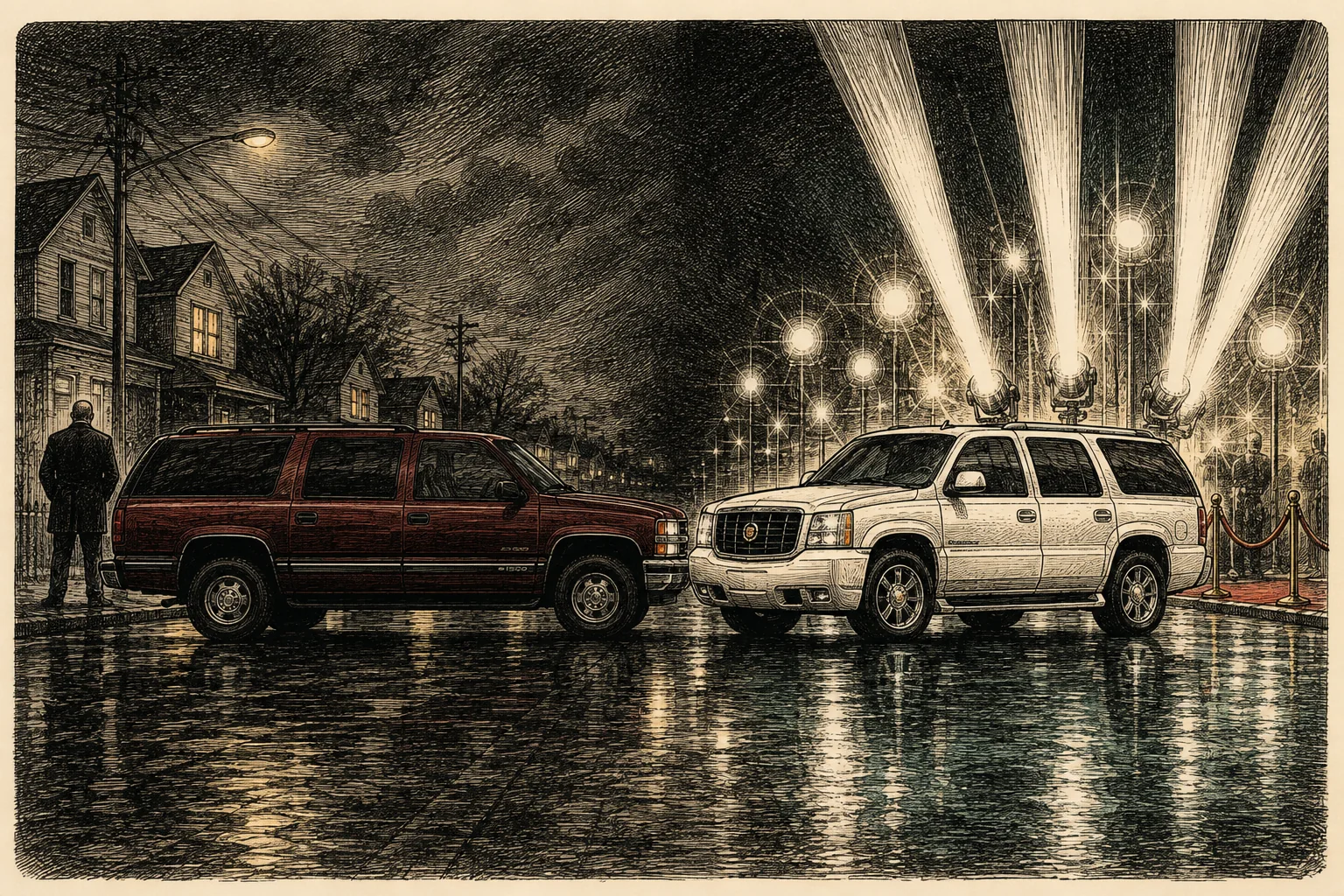
There is a moment in American cinema that the viewer reads faster than the credits. Two or three long black SUVs drive up to the house. The doors have not yet opened, the license plates are not visible, the sirens are silent. But it is already clear: people with powers, money or very bad news appeared in this scene.
Usually this is a Chevrolet Suburban. Sometimes Cadillac Escalade. In terms of design and silhouette, they are close relatives: a high hood, dark windows, a lot of space behind the second row. But in American culture their roles have long diverged. Suburban arrives on business. The Escalade arrives to make sure its arrival is known.
The label "cop-coded" is not meant literally. The point is not that every black SUV belongs to the police or intelligence agencies. This is the screen code. The car is similar to the transport of those who can block the street, ask to step aside and not explain the reasons. The viewer completes the rest himself.
The car built to be useful
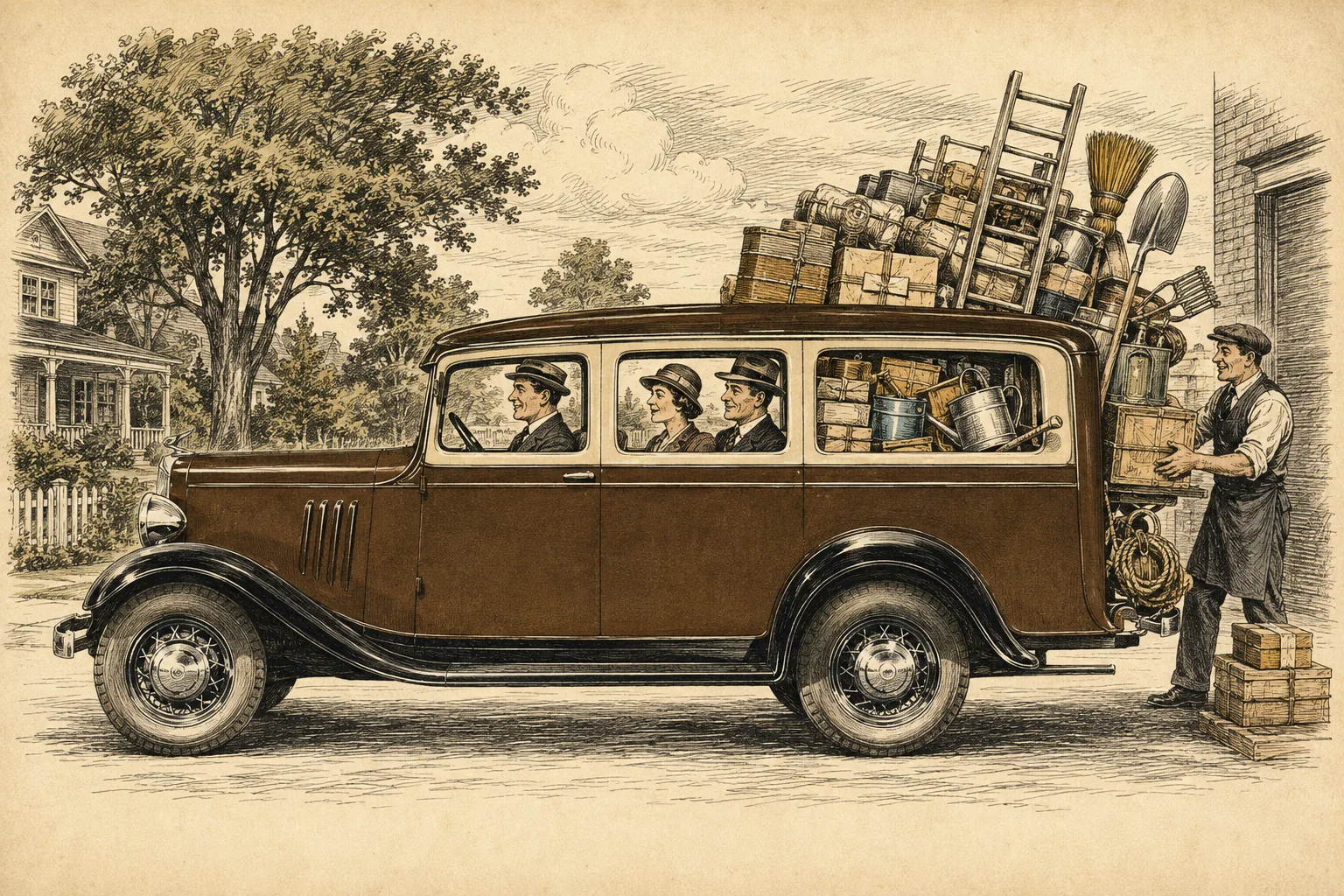
The Suburban appeared in 1935 as the Chevrolet Suburban Carryall: a utility vehicle that was given windows and seats for passengers. The school bus might not make it to the dirt road, and a regular station wagon couldn't accommodate the entire team and its equipment. The Suburban could accommodate both people and cargo. There was no romance in this design from the very beginning. It was bought where the car was supposed to work all day, and not just stand beautifully near the house.
Hence its strange cultural stability. The Suburban has survived body changes, gas crises, minivan fashion and several waves of talk that big cars were about to disappear. In 2025, the model turned ninety years old. Chevrolet calls Suburban the longest-running automobile name in American manufacturing.
Across ninety years, the Suburban has never had a single typical owner. In one scene it carries a family and the supermarket shopping; in the next, a security detail. Out of town it pulls a trailer. At an airport it waits for someone best left unfilmed. That range made the Suburban part of American infrastructure. It need not look luxurious. It only needs to convince us that people, equipment and a contingency plan will fit inside.
The US government did buy and operate Suburbans. In open lists of departmental transport, such vehicles are found in various federal structures; historical catalogs record Suburban and Secret Service. But the screen image has grown wider than reality. The black body and tinted windows made it a universal sign of the “feds”, even where the plot included private security, a television crew, or a rich family with bad neighbors.
A Suburban proves nothing by itself. It is more like a service suit from a TV series: different characters wear it, but the viewer understands in advance that the conversation will now be unequal.
The person inside need not be an agent
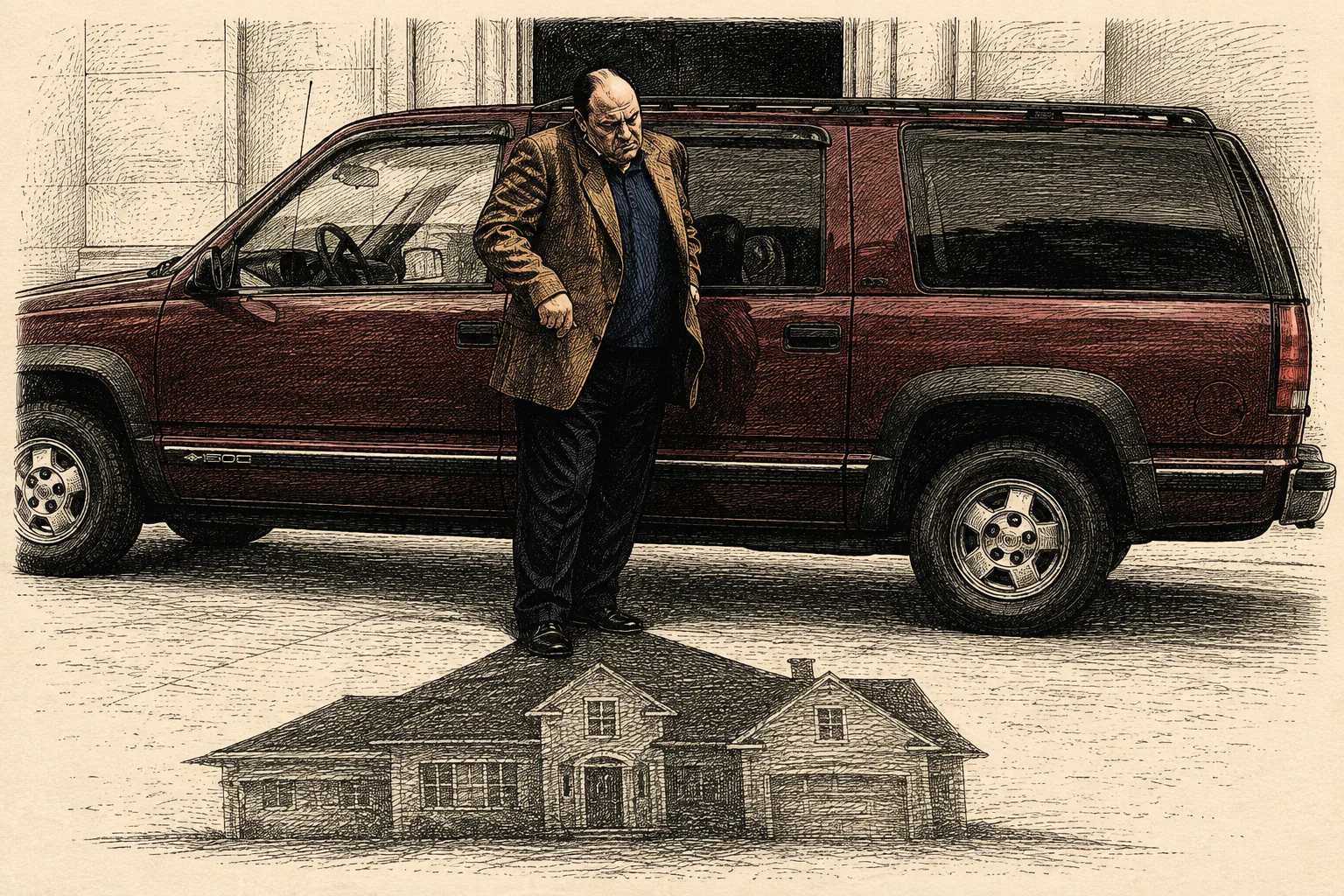
In The Sopranos, Tony Soprano's Chevrolet Suburban works exactly like that. It is neither a don's limousine nor the sports car of a man trying to impress the valet. It has room for a family, minders, boxes, the anger left by a bad day, and Tony himself, trying to pass for an ordinary suburban father. The car does not diminish his power; it makes that power look ordinary.
This is the power of the Suburban as a prop. It knows how to look more modest than its owner. The American crime series loves this effect: a man is dangerous, but he drives something that he could use to take children to training. A large SUV allows you to combine a house and a threat in one frame. There is enough space in the trunk for folding chairs and for someone else's secret.
Cinema quickly established this silhouette. In action films and political thrillers, Suburban appears next to the motorcade, in surveillance scenes, at a country house where no one has invited guests. The viewer does not need to know the trunk volume or engine power. It is enough to see several identical cars, placed so that it is impossible to pass between them.
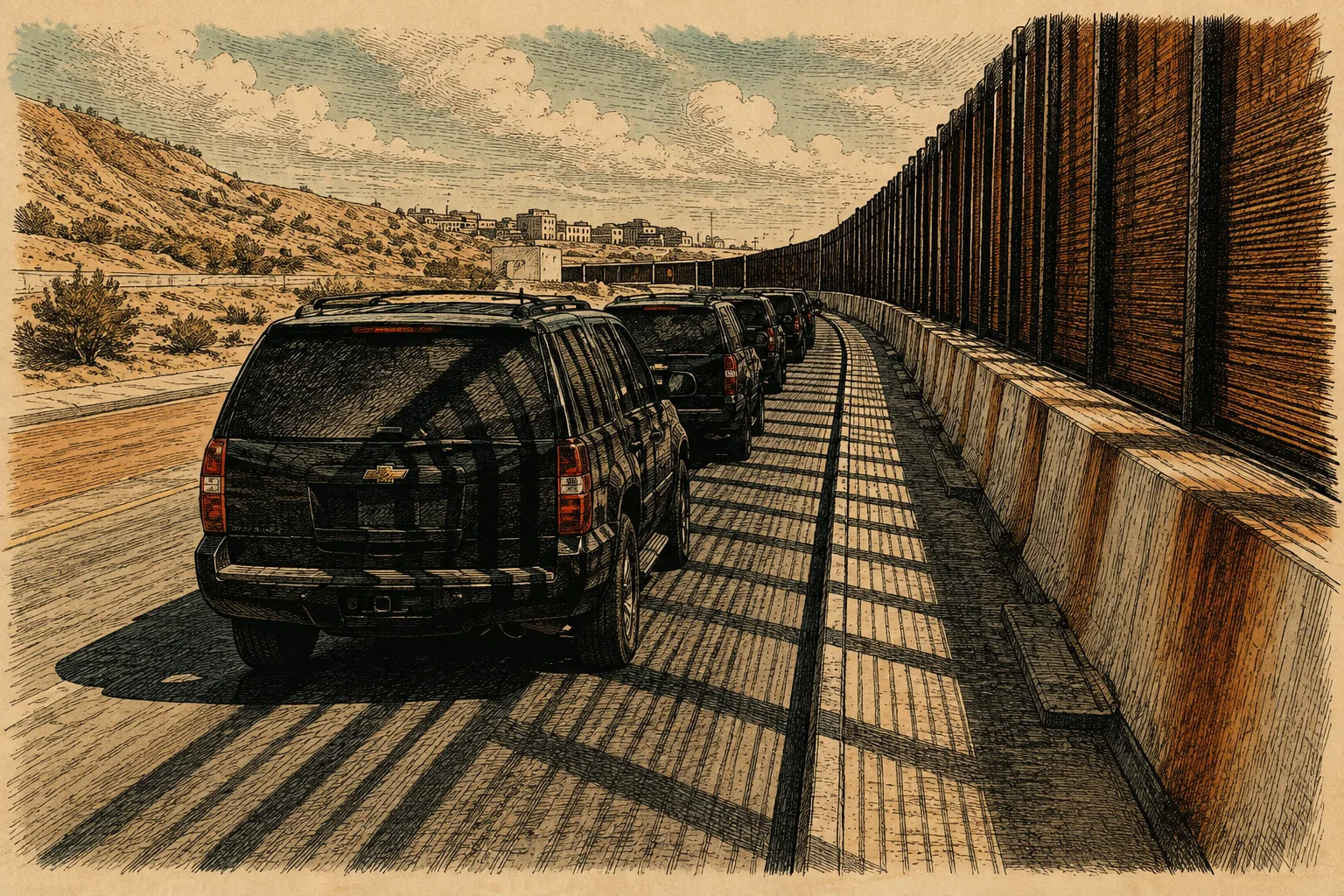
B Sicario this work is performed by the Chevrolet Tahoe, the closest relatives of the Suburban. Black SUVs move along the wall on the US-Mexico border in a dense column. The camera follows them, and the identical bodies turn the trip into a military operation even before the first shot. For such an image, it is not the nameplate that is important. The weight of the car, the blank glass and the sense that the convoy has the right of way are important.
American pop culture made the Suburban look official without giving it a light bar. It resembles the state at the moment the state arrives in person, carried by a group of people in identical jackets.
The Escalade arrived too quickly to be modest
The Cadillac Escalade was born out of a different kind of anxiety. In 1998, the Lincoln Navigator proved to the market that buyers were willing to pay for a large SUV with a luxury interior and a separate status. Cadillac didn't want to be left out. The first 1999 Escalade was prepared quickly: General Motors directly calls it a response to the Navigator and acknowledges its kinship with the GMC Yukon Denali.
This was not the case when a brand has been cultivating a new idea for many years. Escalade appeared with an almost ready-made silhouette, but immediately received a Cadillac grille, leather, wood for the interior and its own name. The word itself escalade means storming a fortification using ladders. For a car that was supposed to bring Cadillac back into the conversation about prestige cars, the name was almost honest.
At first there was something comical about it. The old Cadillac was associated with long sedans, Florida retirees and commercials where no one raised their voice. The new Cadillac turned out to be a truck. But it was the truck that brought excitement back to the brand. The Escalade could be raised higher, put on huge wheels, and equipped with music so that the neighbor's house could also participate in listening. It did not hide its bulk or price. It made virtues of both.
GM later recalled that prominent athletes and artists began buying Escalade without waiting for an invitation from the brand. In the videos, the model received the "'Slade" abbreviation, huge wheels and chrome. There's an important detail here: the Escalade wasn't designed by the advertising department to be a hip-hop machine. Hip-hop itself has designated it as a convenient subject for conversation about success.
When Cadillac became a word from a song
Cadillac was present in American music long before the Escalade. An old Cadillac meant quality, money, status, and sometimes just the dream that life was more than a cramped apartment and someone else’s job. But Escalade came to an era when this status had to be shown close-up rather than described.
In the early 2000s, rap and R&B made the SUV a regular feature in music videos. It worked well on camera: tall, shiny, with a large door from which you can slowly exit. Unlike the sports coupe, the Escalade didn't talk about speed. It said that you had already arrived and you don’t need to rush anywhere.
It wasn't just the aesthetics of wealth. For many artists and listeners, an expensive car remained a sign of the distance traveled: not an inheritance, but a visible result of success. Therefore, to crudely reduce this image to “window dressing” would be as lazy as calling any song about money an advertisement. In popular music, the Escalade has often been an award, armor and stage all at once.
Automotive journalists in the early 2000s noted that the Escalade was infiltrating text and video faster than Cadillac could figure out how to speak to that audience. Later, the brand included hip-hop in its own anniversary projects and directly spoke about its connection with the genre. Cadillac didn't write this biography from scratch: it acknowledged that the Escalade already lives in music without its permission.
Relatives who chose different professions
Movies often put Suburban and Escalade side by side. Both have enough space to seat a large group. Both can be black, expensive and unfriendly. Both look great at the entrance of a hotel, in a studio parking lot, or outside a private home in the series. But one usually works in the background, and the second comes to the foreground.
The Suburban keeps its importance to itself. Its driver could be a father, an agent, a bodyguard, an aide to the governor, or the man who fixes the cables at the stadium. The car does not answer the question of who is inside, and this is a little alarming.
The Escalade does the opposite. It offers an answer before the passenger has even gotten off. Inside there must be someone who managed to earn, inherit, take away, or at least convincingly play the right to such a car. The Escalade doesn't have to be owned by a celebrity. But it likes being mistaken for a celebrity's car.
However, over time, the border blurred. Today, the Suburban can be finished as well as a luxury SUV, while the Escalade is used by security guards, officials and drivers who simply need a very large interior. On real roads the roles are mixed. Pop culture still distributes them according to the old script.
Why the meme doesn't die
On the Internet, a black Escalade without markings often turns into a joke about “they’ve come for you.” A black Suburban means that a scene in an American film is no longer safe. In both cases, what's funny is that the viewer recognizes the code instantly.
This code is sustained by decades of repetition. America filmed big cars near the White House, a school, a shopping mall, a rap video and a crime scene. The same body received too many roles, but did not lose readability. We don't know who's sitting behind the tinted glass. But we know: the person inside either came to solve the problem, or wants everyone to think that he is solving it.
Suburban and Escalade are therefore not so much cars as two American verbs. Suburban comes, picks up, covers and takes away. Escalade appears. The first one has a task. The second has an entrance.
Sources
General Motors Heritage: Cadillac Escalade 1999
General Motors: the history of the Chevrolet Suburban
DHS Police Car Archives: United States Secret Service
MotorTrend: Escalade in pop culture
Los Angeles Times: How the Escalade Became a Pop Culture Star